
In March 2026, as governments wrapped up the first part of the International Seabed Authority’s 31st session in Kingston, Jamaica, the list of outstanding issues in the draft Mining Code – the rules and regulations for mineral exploitation in international waters – remained substantial. In this blog post, TwinPolitics Researcher Emil W. Hildebrand takes a deep-dive into one central issue from this list: deep-sea data and, more broadly, how the ISA is positioning itself as a data authority in deep-ocean governance.
Written by Emil W. Hildebrand
This activity is conducted as part of the Collaborative Event Ethnography (CEE) under the TwinPolitics project, led by Prof. Alice Vadrot and funded by the European Research Council. Other venues include the BBNJ Negotiations, negotiations for a global Plastics treaty (INC) and the Convention on Biological Diversity (CBD). A special thank you is extended to TBA21 for providing access to the ISA July 2025 negotiations through their observer status.
This blog post assumes some familiarity with the ISA. For an introduction to the Authority’s work and an overview of major issues being negotiated, see my report from the ISA’s 30th session.
Deep-sea data is critical to how we understand, govern, and protect our oceans. I am not the first to say that we know very, very little about the deep sea. It is vast, deep, and very hard to reach, making data both difficult to come by and highly valuable.
The International Seabed Authority (ISA) already has a considerable amount of deep-sea data on its hands. This includes data from 25 years’ worth of contractor exploration activities, as well as experience hosting projects such as the DeepData database, the Sustainable Seabed Knowledge Initiative, the Deep-sea Biobank, and the Area2030 project for the international seabed. The ISA has positioned itself as a leading provider of deep-sea data also beyond its own jurisdiction. It has already signed a memorandum with the Food and Agriculture Organisation (FAO) that includes data-sharing, and during negotiations on the Agreement on the Conservation and Sustainable Use of Marine Biological Diversity of Areas beyond National Jurisdiction (BBNJ Agreement) and meetings of the Convention on Biological Diversity (CBD) it actively highlights its data expertise.
This orientation towards data stewardship is becoming an increasingly important source of legitimacy for the ISA. It seems safe to say that the ISA is, both in self-perception and practice, becoming a leading authority on deep-sea data.
There is one caveat, however: The ISA’s data comes primarily from mining contractors.
Contractor-sourced data is not inherently negative, but it has implications for ocean governance. Important issues include questions of data quality and scope, independent review mechanisms, and confidentiality provisions.
This seems to me a very central but quite undercommunicated issue in the discussions surrounding deep-sea mining. There is talk of evidence-based decision-making and filling in knowledge gaps, but less so about who exactly creates the data underpinning this evidence or enabling this knowledge – or how that data is managed. It is worth unpacking.
In this blog post I look at three central questions:
- How is the ISA’s data created?
- How is contractor data discussed during ISA negotiations?
- What are the implications for evidence-based decisions-making?
To help me along the way I draw on the TwinPolitics project’s complete dataset of statements from the last one and a half years of ISA negotiations – collected using our structured field note-taking method – where ISA member states are in the midst of discussing (among other things) exactly these issues.

Figure 1: Fieldwork at ISA Negotiations in Kingston, Jamaica. Photo credits: Author and Giulia Champion
1. How is the ISA’s data created?
Mining contractors are required to collect and report data to the ISA under their exploration contracts. This includes environmental data, which is publicly available, as well as geological and bathymetric data, which is so far kept confidential for commercial reasons1 . This data is what populates the DeepData database, accessible via the ISA’s web portal. The data reported by contractors forms the basis for some of the most central environmental protection measures of a future deep-sea mining regime, including environmental baselines, environmental impact assessments, and regional environmental management plans (REMPs).
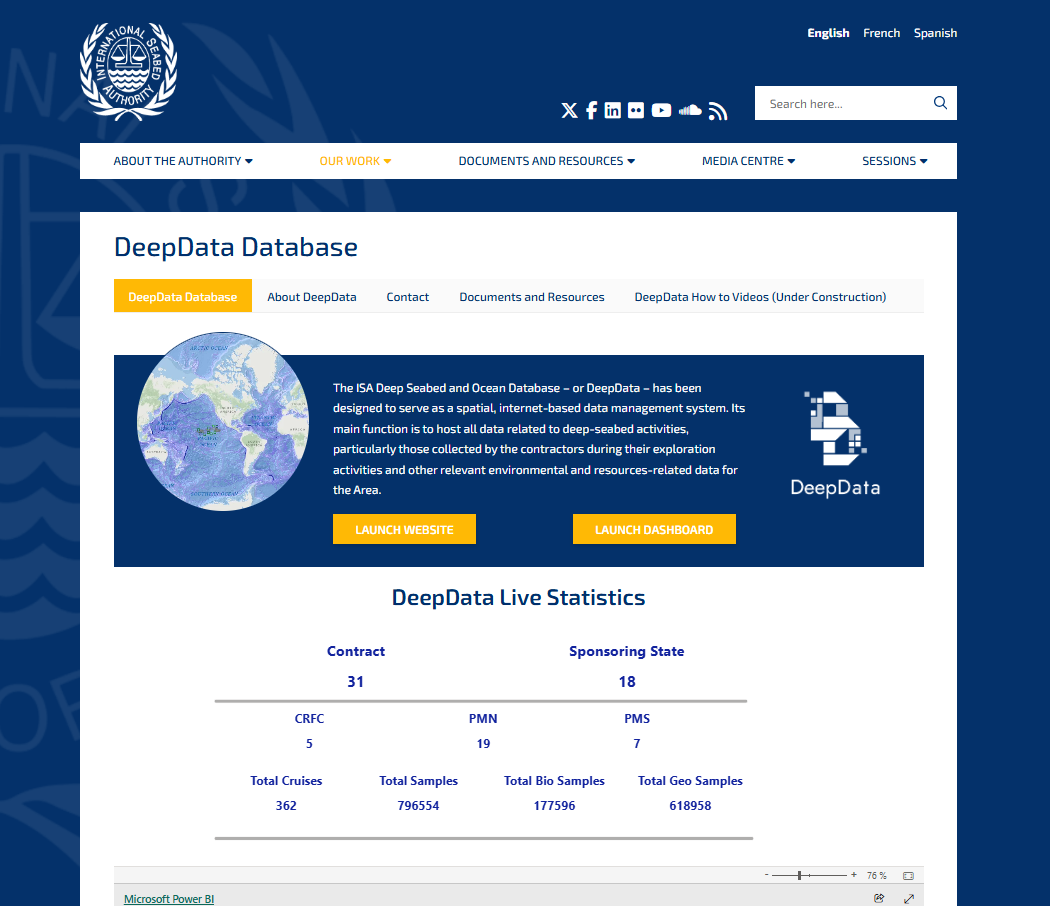
Figure 2: Landing page of the DeepData database: https://isa.org.jm/deepdata-database/
The ISA’s data, then, comes directly from mining contractors. It is important to keep in mind that these are companies with large financial incentives to start exploitation of the deep seabed.
But the image is slightly more complex. Contractors often partner with scientific institutions2 for their data collection, where independent scientists join contractor cruises and have their research funded in return for providing the contractor with baseline data. Important scientific work is being done in conjunction with contractors, and the results are far from always in the contractor’s favour. In a sense it is a win-win situation: The data is collected by independent researchers, and the actors who stand to profit carry the financial burden. Not a bad arrangement, in and of itself.
But this close link between industry and science (or the ‘Faustian pact’, as some have labelled it) has to raise at least some concerns about the true independence of the data collected. The scientific community itself is grappling with the question of whether or not to work with contractors; I can recommend this great article. Not all contractors are well-behaved, either. Some have better track records of ensuring the independence of scientists than others, if we are to believe the rumours. A number of contractors also fail to fulfil their annual environmental reporting requirements, as noted by the Legal and Technical Commission (LTC) – the ISA expert body tasked with reviewing contractor data.
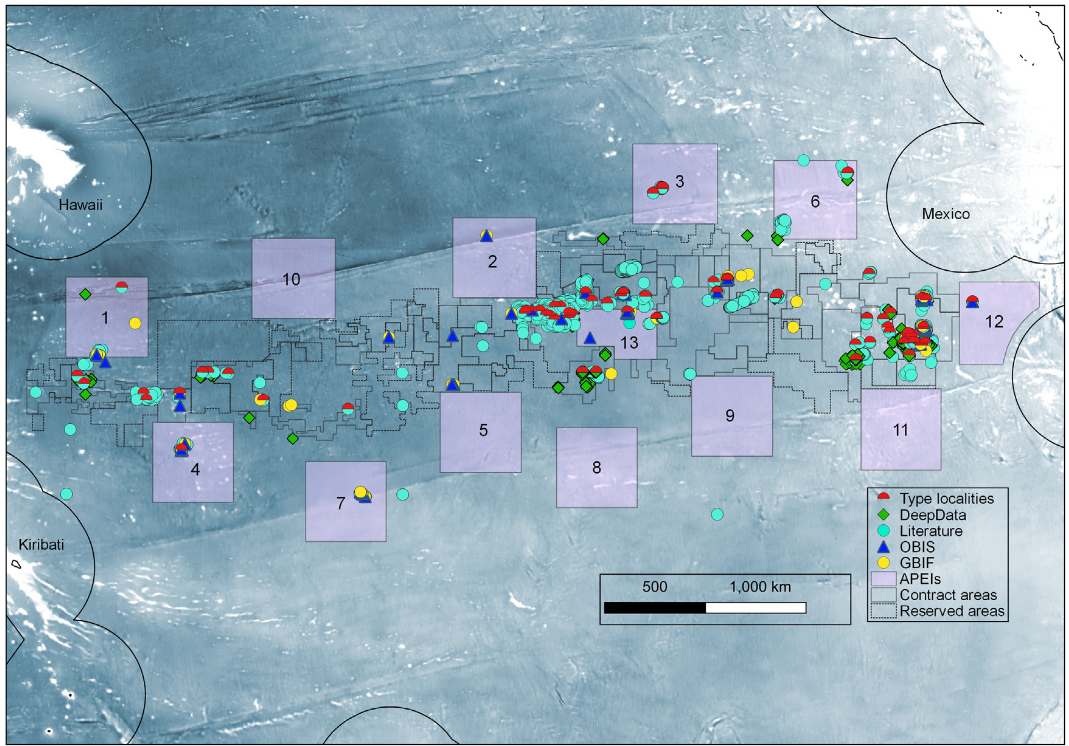
Figure 3: All geolocated published records of metazoan species in the Clarion Clipperton Zone from DeepData, other public databases, and the broader scientific literature. From a comprehensive 2023 study by Rabone et al.
The issue is just as relevant for the future. In the Council negotiations this March on monitoring requirements in the Mining Code, Germany stressed the ‘need to incorporate independent monitoring into the draft regulations to ensure the authority does not only rely on contractor generated data, which would be inherently risky’ (statement delivered in Council on March 9th, 2026, emphasis added).
Regardless of how solid contractor-sourced data may be, there is another and perhaps more systematic issue with the way the ISA’s data is created. Since the issue at hand is deep-sea mining and most of the data collection is done by contractors, the data very naturally comes from within exploration contract areas. In other words, the existing data (almost) exclusively covers areas where mining is meant to happen (see Figure 3). Nature, however, could not care less about arbitrary lines drawn on a map.
In fact, one of the defining features of the deep sea is that it is extremely diverse, highly interconnected, and often very localised. Species found in one exploration area might not exist two areas over, let alone in the adjacent protected areas of particular environmental interest (APEIs) or beyond. Understanding this spatial variation and the connections between ecosystems is essential to any reasonable environmental management. The LTC has apparently ‘encouraged’ contractors to ‘conduct environmental studies outside their contract areas’ – in other words they have asked them nicely. If contractors do collect this data, however, is entirely up to them.
To put it simply: No matter how good the ISA’s data may be(come)3, it remains both financially and geographically tied to deep-sea mining. This is, in my view, a critical point.
2. How is contractor data discussed during ISA negotiations?
Data-related negotiations at the ISA Council broadly revolve around how to best manage this contractor-generated data: How and by whom the data is to be assessed, how strict the reporting standards should be, and what data should be made publicly available.
The current draft version of the Mining Code, the ‘Further Revised Consolidated Text (rev. 2)’, contains several draft regulations (DRs) relating directly to these questions. Some provisions have generally been agreed upon – others are more contentious. Figure 4 gives an indication of which DRs saw the most discussions on data as a topic4. Let’s briefly examine the top scorers: DRs 3 and 89-915, and what conflict lines exist between member states.
Draft regulation 3 is titled ‘Duty to cooperate and exchange of information’ and contains provision f(i) stating that the ISA and contractors ‘shall cooperate […] with a view to: sharing, exchanging and assessing environmental data and information for the Area, including by use of data repositories and open-access databases’. This lays out a duty of the ISA and contractors to share their data publicly. Some delegations took to the floor asking to have the word ‘environmental’ deleted. In other words, that all data be shared, unless explicitly falling under the data confidentiality rules outlined in DR89.
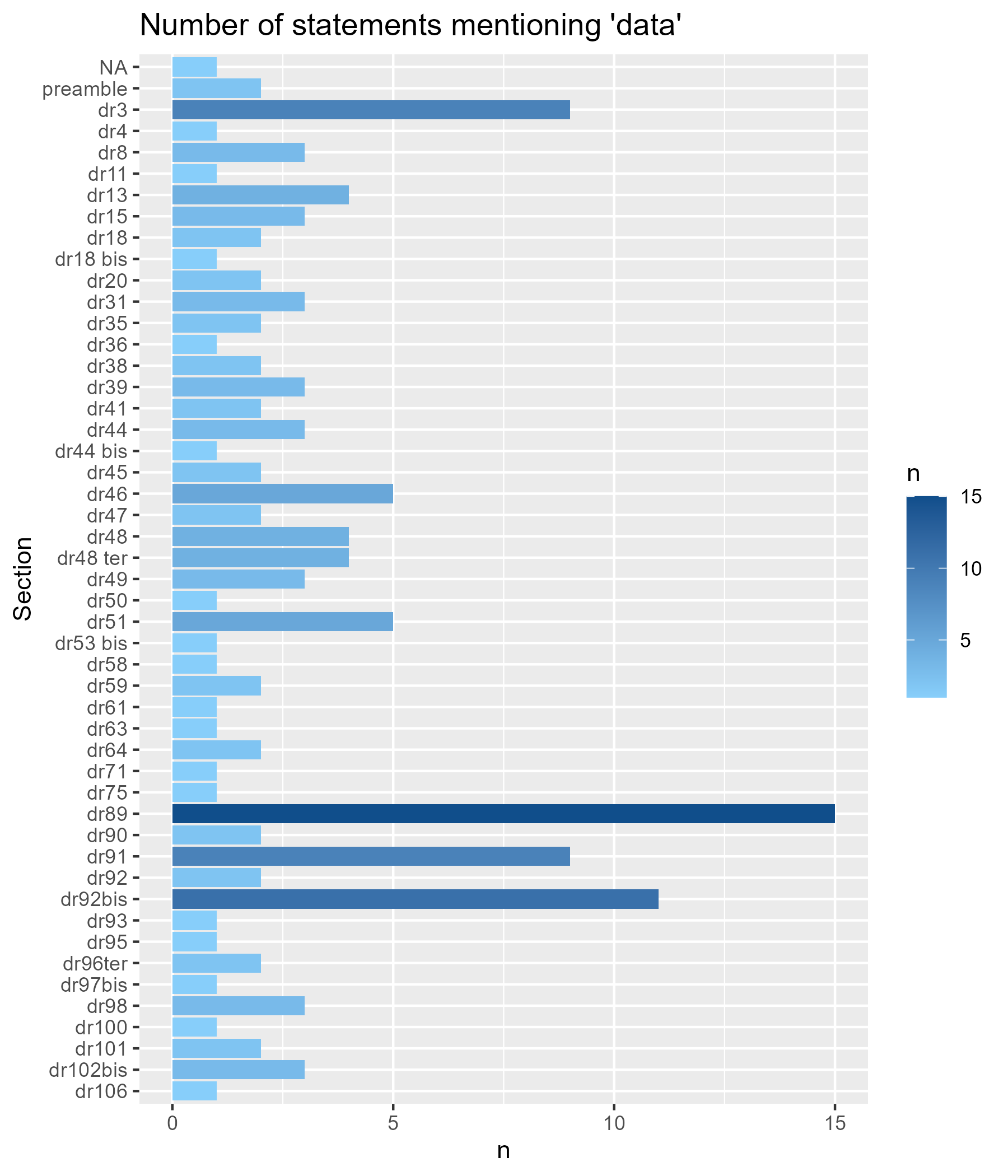
Figure 4: Number of statements mentioning “data” per section of the draft Mining Code during the ISA Council’s 30th Session Part and II (2025)
This is emblematic of a larger debate about what contractors are allowed to keep secret for commercial reasons and what they are obliged to share with the public. One must keep in mind that the public in this case also includes the ISA Council and its member states – the decision-makers – who otherwise do not have access to confidential data.
Portugal made an interesting case for why all data should be public by default:
Mineral resources of the Area are the common heritage of humankind, and the revenue they generate are meant to be distributed equitably for the benefit of all. That means that information pertaining to mineral resources and economic information in relation to its commercial exploitation are of interest to all and should be public.
Statement delivered in Council on March 17th, 2025
In other words, since the international seabed is the common heritage of humankind, the data on it should also be made public.
Could we even say, without putting words in Portugal’s mouth, that the data itself should be considered part of the common heritage? Deep-sea data is certainly strongly connected to questions of equity, and it forms a key part of the ISA’s capacity-building obligations. This might help explain the active focus of the African Group on data-related issues, as illustrated in Figure 5. Deep-sea data as part of the common heritage of humankind warrants more thinking – and more space than what I have in this blogpost.
Draft regulations 89-91 further address issues of data confidentiality. The Council saw heated debate (by diplomatic standards – read: completely civil and calm) on questions such as what counts as environmental data, what data is allowed to be confidential, and who gets to make those decisions. All the specifics are too nitty-gritty to dive into here, but in general the pattern is that mining-oriented states want more data to fall under confidentiality provisions, whereas more mining-critical states push for as much public data as possible.
Some states want the concept ‘Environmental Data’ to be defined as a term in the Schedule (the ‘word book’ of the Mining Code where much-used terms get precisely defined). Its definition would have big implications for how much contractor data will be publicly shared in the future. The Deep Ocean Stewardship Initiative (DOSI) proposed to include ‘at a minimum, all physiochemical, geological, atmospheric and biological information’ collected by contractors within and outside their contract areas. This is wider than the split between environmental (public) and geological (confidential) data currently used for exploration data in the DeepData database.
In fact, the definition in the current Mining Code draft proposal is very narrow: It only exempts environmental data from confidentiality provisions when it relates ‘to the Protection and Preservation of the Marine Environment’ (DR89 para. 3f). Many delegations stressed that at a very minimum, all environmental data should be public by default, not just the specific data deemed necessary for marine protection by…
Whom exactly?
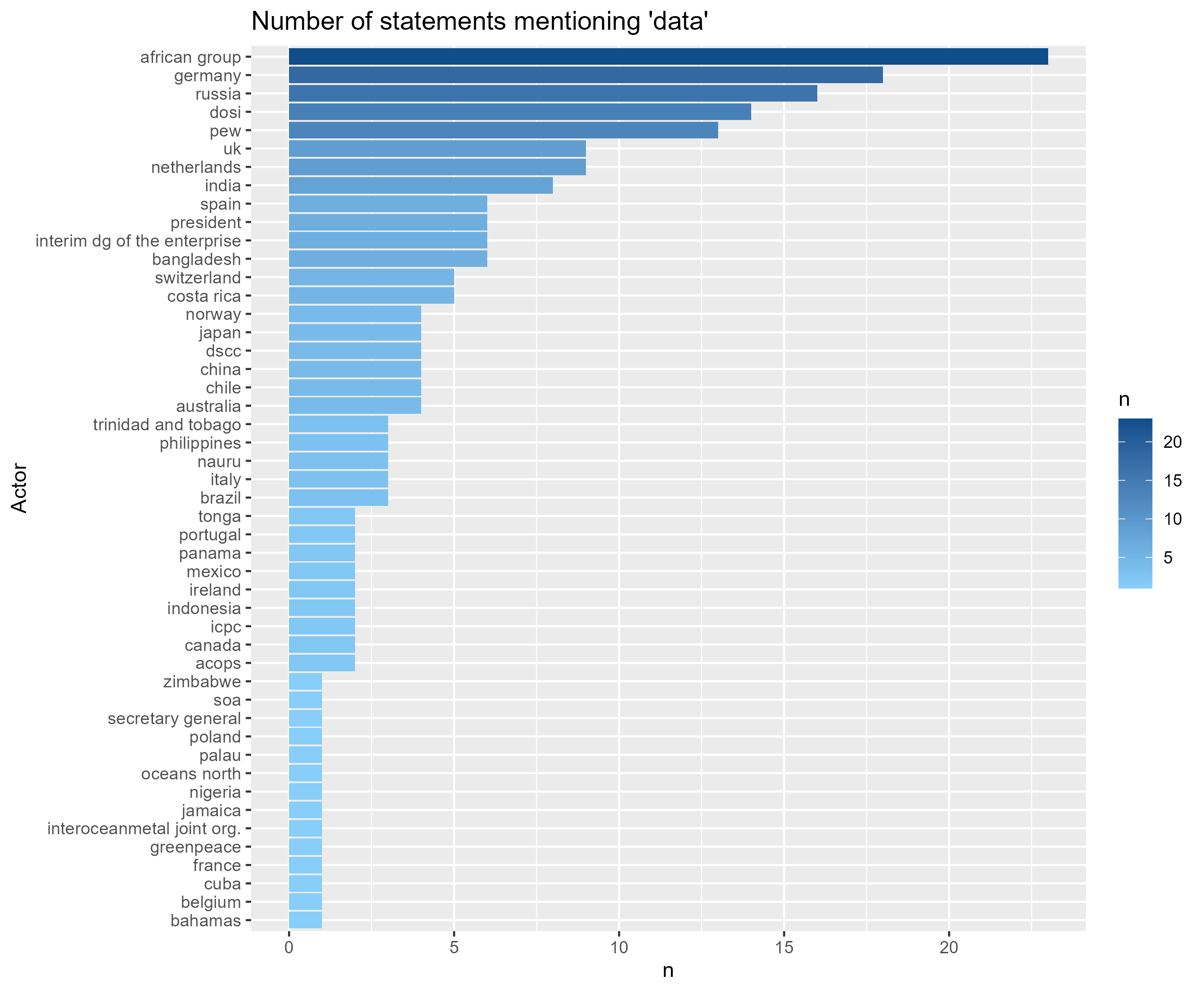
Figure 5: Some delegations are more focused on data than others.Number of statements mentioning “data” per actor during the ISA Council’s 30th Session Part I and II and 31st Session Part I (2025-2026)
Here is another point of divergence which is mirrored across discussions on the Mining Code. Which part of the ISA should handle what and when? Is it the Secretary General and the secretariat? The Council and ISA member states? Or the Legal and Technical Commission (LTC)?
On issues of data, the choice usually falls on the LTC. Formally a subsidiary body of the Council, the LTC consists of a group of experts from various fields nominated by member states and working on a voluntary basis. The LTC holds all its meeting behind closed doors and has more than once been criticised for intransparency, secrecy, and at times close industry connections. It is chronically overworked, with ever more tasks being delegated to it or foreseen as part of its mandate in the future. Not to say that the LTC doesn’t consist of true experts doing good work, it certainly does, but there are legitimate reasons to question whether it has the capacity, resources, or transparency needed to handle all its tasks – including data assessment.
Some delegations have proposed a dedicated Data Committee (notably Germany), but this idea seems to lack the traction needed to establish a wholly new body within the ISA. Other options could be reforming the LTC, including its funding, election rules, and internal structure. At the very least, opening up to independent and external review of contractor-submitted data seems imperative, something multiple delegations have stressed during the negotiations. Regardless of the solution, who oversees the collection, assessment and management of contractor data will have implications for its quality and robustness.
3. What are the implications for evidence-based decisions-making?
What does all this mean for ocean governance and the increasingly central ideal of evidence-based decision-making?
The main issue about deep-sea data is and remains that we do not have enough of it. But even where data already exists, we should proceed with caution.
There is no questioning that the ISA’s data is valuable in terms of laying the foundations for a better understanding and eventually preservation of the marine environment, and I think we are better off with it than without. The ISA is also continuously working on improving its data infrastructures and the usability of its data. But we should not forget its limits. It is clear that relying on contractor data has some obvious pitfalls, and discussions on the rules for quality, robustness, and independent assessment of this data are ongoing. It is also worth noting that however strict a future Mining Code will be, its provisions will not apply to the 25 years of data already collected by contractors.
The LTC itself has noted that more diverse data is needed when creating environmental management plans for deep-sea mining. The same applies when this data travels beyond the jurisdiction of the ISA to other institutions such as the BBNJ Agreement, which may seek to make decisions based in part on the ISA’s data. What happens when we are two degrees removed from the source? Or, taking it one step further yet: What if the data were to be integrated into future decision-making tools such as the European Digital Twin Ocean (EUDTO)? What sort of biases would potentially transfer and get hidden beneath layers of modelling?
It seems clear that for the ISA to justify its continued bid as a deep-sea data authority it needs to ensure transparent and robust management of its contractor-sourced data, including external oversight and rigorous assessment procedures.
Crucially, the ISA needs to decouple its data capacities from mining activities as much as possible, including working towards a greater diversity of data and by making sure that commercial interests do not override environmental concerns in terms of confidentiality and open data sharing. In a sense, the ISA may benefit from adopting something akin to a dual personality: The ISA as a mining regulator on the one hand, and the ISA as a scientific institution, data steward, and environmental custodian on the other.
Anything else may hurt the ISAs legitimacy as a data authority or, in a worst-case scenario, negatively bias future governance decisions made based on its data.
1 Contractors can voluntarily publish their bathymetric data as part of the Area2030 initiative. Only 5 have volunteered so far, according to the ISA’s own website.
2 Some contractors are scientific institutions, ref. the French contractor IFREMER
3 The DeepData database has experienced some teething problems. I note this comment from an ISA-led workshop on APEIs in 2019: ‘Despite efforts by some workshop participants and the ISA Secretariat, the use of data contained in the ISA database (DeepData) for the workshop deliberation was rather constrained by issues relating to data quality, data validation and completeness of information.’ But the ISA is working on it.
4 The 2025 negotiations were used when making this figure, as Council went away from a regulation-by-regulation negotiation format in 2026. It is worth keeping in mind that other words such as ‘monitoring’ and ‘information’ is not included here.
5 DR92bis covers what happens if an exploitation contract expires or is cancelled. A very interesting question, especially with ongoing discussions on breaches of contractor compliance, but too much to get into here.