The world of deep-sea mining can be confusing to the outsider, and it is moving fast. Our researcher Emil W. Hildebrand was in Kingston, Jamaica for two weeks to observe part II of the 30th Session of the International Seabed Authority (ISA) and gives you his recap of the most important outcomes (or lack thereof) from the negotiations.
Written on site by Emil W. Hildebrand
This activity is conducted as part of the Collaborative Event Ethnography (CEE) under the TwinPolitics project, led by Prof. Alice Vadrot and funded by the European Research Council. A special thanks is extended to TBA21 for providing access to the negotiations through their observer status. In addition to the ISA (see Emil’s blog post on Part I of the ISA Council’s 30th session here), other venues include the International Negotiating Committee (INC) on a Plastic Treaty and the BBNJ Negotiations.
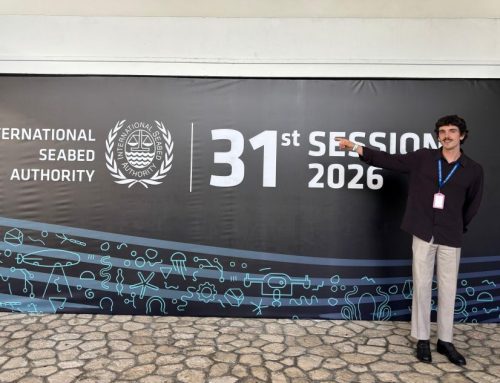
 Emil W. Hildebrand observing at ISA (Source: Emil W. Hildebrand)
The 30th meeting of the ISA’s Council and Assembly were, as always, both eventful and contentious. The Council finished their second reading of a draft Mining Code, but big divergences remain. US unilateral action keeps looming over the process and new states are calling for a moratorium. The Assembly once again clashed over the need for a general environmental policy and a periodic review, both of which were blocked by a few member states. Questions on a benefit-sharing mechanism and the economic feasibility of deep-sea mining were raised, with countries asking: “is this really worth it?”. Finally, the Council decided to formally look into The Metals Company and their US-deal, asking whether a company can undermine the multilateral system and benefit from it at the same time.
As the 30th session wraps up, states and observers are once again left to consider the big question: What next? A question that increasingly applies to not just the Mining Code, but to the future of the ISA as a whole. What sort of institution will it be going forward? What is its role in a world of increasing geopolitical tensions, deep-sea mining pushback, and calls for more marine scientific research?
But first, let’s cover the basics: What is the International Seabed Authority (ISA), and what actually happened during its three weeks of negotiations in July? If you’re already familiar with the ISA, this next section is the part you can skip.
A beginner’s guide to the ISA
The ISA is the organisation tasked with governing the international seabed and its resources for the common heritage of humankind. It was established under the UN Convention on the Law of the Sea (UNCLOS) but is a free-standing organisation with 169 member states + the EU. Its mandate is threefold: Establish a regime for managing resources found in the deep seabed, protect the marine environment, and promote deep-sea scientific research.
The ISA’s current main preoccupation is developing a Mining Code – the rules and regulations for commercial exploitation of the deep seabed. In other words, the rulebook for deep-sea mining. Until the Mining Code is in place no country is allowed to mine the deep-sea according to international law (although some want to, more on that later).
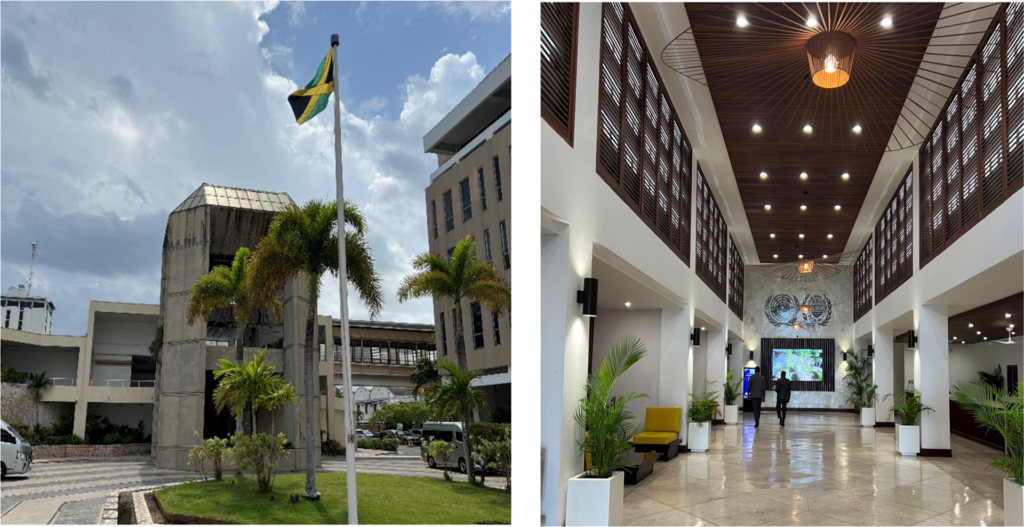
Entrance to the Jamaica Conference Centre in Kingston (Source: Emil W. Hildebrand)
The two main organs of the ISA are the Council and the Assembly. The Council consists of 36 member states, elected on a rotating basis according to a delightfully complex set of rules, and is the main organ in charge of developing the Mining Code. Council negotiations can be technical, dry, and seemingly impenetrable for anyone accidentally stumbling into the ISA WebTV or the Jamaica Conference Centre in Kingston, but all the more important as this is the forum where the potential implementation of deep-sea mining is negotiated. If and when the Council finishes the Mining Code, it sends its recommendation to the Assembly for approval.
The Assembly is the ISA’s supreme organ and consists of all its 169 member states + the EU. This is where broader political debates take place, and where general policies may be adopted. These are policies that apply to all the ISA’s work – including, but not limited to, the Mining Code (also more on that later).
Both the Council and the Assembly can in theory make decisions by a two-thirds majority vote. Established norms and a persistent failure to reach quorum in both bodies, however, means that decisions are made based on consensus. States may launch formal objections to block a consensus, or decisions may be deferred to the next session
The ISA Council gets together two, sometimes three times a year for two weeks at a time (March, July, and October/November when necessary). The July meeting, which is what I attended this time, is always followed by a one-week gathering of the Assembly. It all takes place at the beautiful Jamaica Conference Centre in Kingston, built especially for the ISA in 1983.
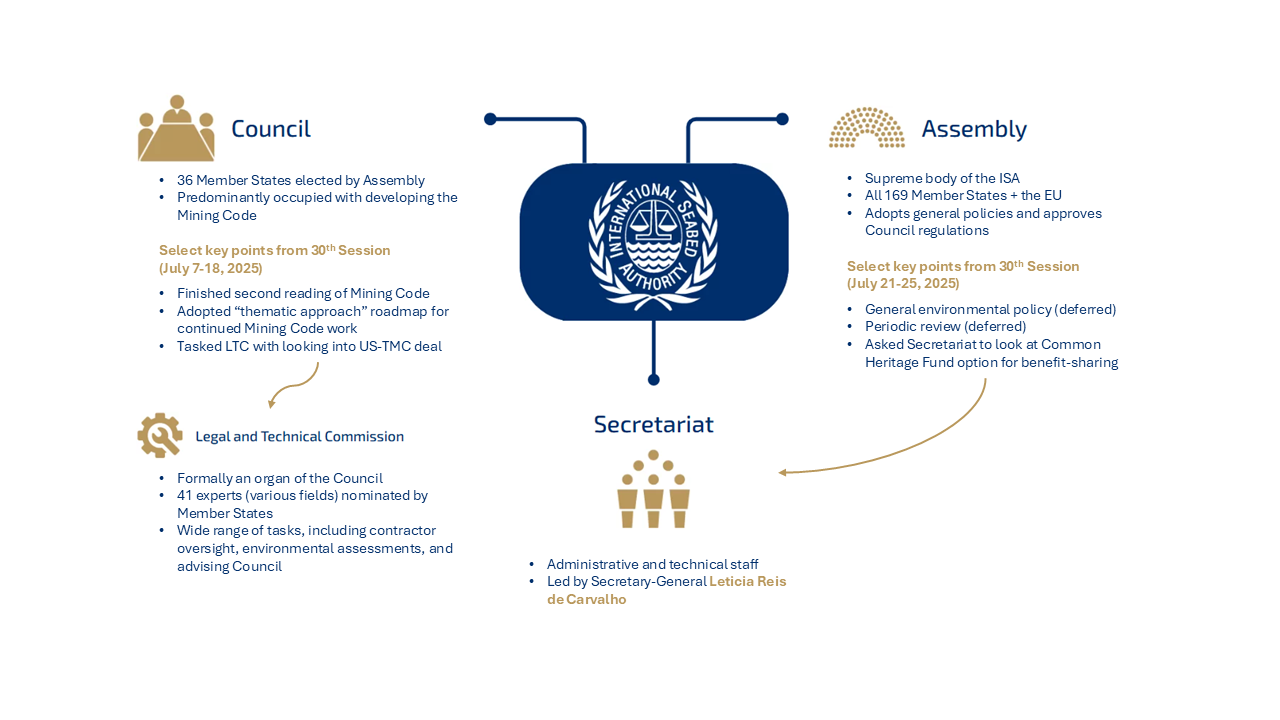
ISA bodies and select key points from the 30th Session. Adapted from original: https://www.isa.org.jm/organs/
Second reading of the Mining Code, what now?
As the Council wrapped up Part II of its 30th session lasting from Monday, July 7 to Friday, July 18, it marked the end of the second full reading of a draft Mining Code – no little feat considering the amount of disagreement that remains between states on virtually every one of the 107 draft regulations currently found in the Code. New to this session was the presence of screenwriters noting down proposals and preferences in real time, leaving the text on screen looking like a beautiful mosaic of divergence between member states’ positions.
According to its own roadmap from 2023, the Council was supposed to adopt the rules and regulations for deep-sea mining by the end of this meeting. This did not happen. It is not difficult to see that a finalised Mining Code is still far away. No matter how diligently and constructive states may work, building a regulatory framework for a new extractive industry in international waters – one that takes environmental protection and the common heritage principle seriously – is a highly complex task that takes time. As Costa Rica put it in a statement during the Assembly: “it would be illusory to disregard that there is still a long road ahead for us”. It was likely clear to everyone involved that the Mining Code would not be finished by the end of this session, making the final agenda point “Adoption of the regulations …” read more like a diplomatic inside joke, or at least an overly optimistic formality.
Looking past the remaining brackets, annexes, standards, guidelines, schedule, and cross-cutting issues that the Council have not yet had the opportunity to discuss, the second full reading leaves in its wake one question, namely: what now? A question countries seemed to have very different opinions on.
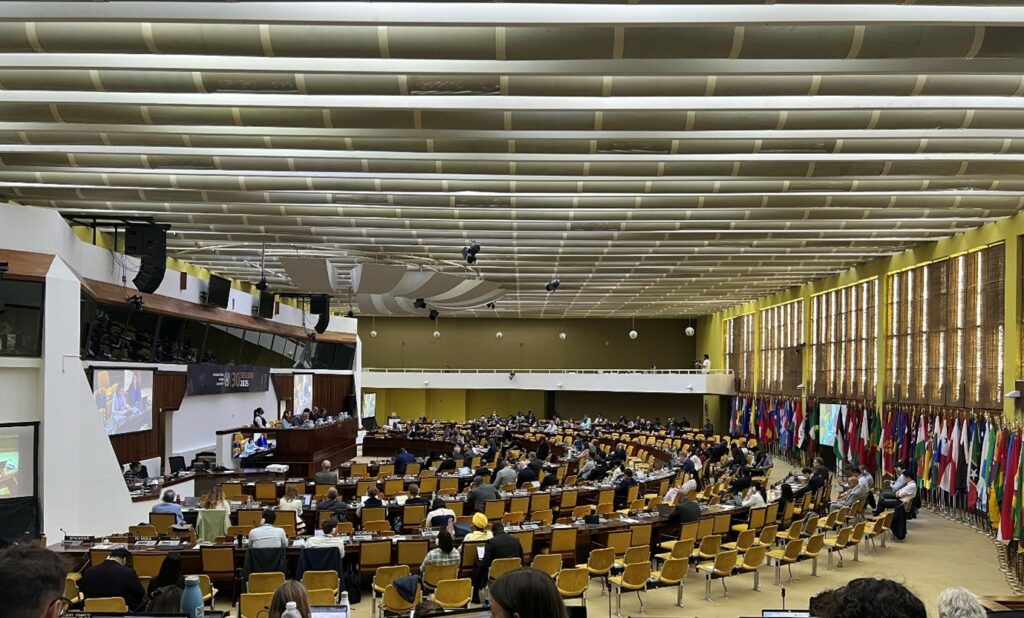
The negotiations as seen from the observer bench (Source: Emil W. Hildebrand)
Much of Council’s last day was used to discuss how to move forward. As mentioned, the last time Council decided on a roadmap it included a set deadline for finishing the Code. This time around Council instead chose to identify key outstanding issues to be addressed rather than setting a fixed timeline for completion. That means no dates, just an open-ended thematic approach. Some countries expressed concern that this would risk further delaying the adoption of a Mining Code and lobbied for keeping the list as slim as possible. Others applauded it as a sober approach to structure the Council’s work ahead and a realistic representation of how much work remains. Given the complexity of the matter and the current track record of deadline-based work on the Mining Code, a thematic approach seems welcome.
For those countries working towards strong environmental regulations or, increasingly, those states calling for a moratorium on deep-sea mining (now counting 38 after Croatia voiced their support during Assembly), a slow but steady process of developing the Mining Code has traditionally been seen as a good thing. So far, the negotiations have been a tug-of-war between countries wanting to start mining as soon as possible and those favouring a thorough, more robust policy-making process – something I wrote about in my report on the previous Council meeting. This time around, however, the latter group is facing a dilemma.
In April, Trump issued an executive order indicating that the US is seeking to engage in mining the international seabed, threatening to circumvent the ISA’s authority and international law. The question of whether the US is bound by this law as it never ratified UNCLOS is still being debated, but the pressure this decision puts on the Mining Code negotiations is nevertheless significant. Some see the threat of unilateral action as a reason to finish the Mining Code faster. As one speaker argued:
There are those who would say, now, if the regulations are there, exploitation will go on and all mayhem will be let loose. No, in fact, mayhem is going to be let loose as long as there are other takers willing to come and occupy the space, because we are doing nothing.
The fear being that without a finished Mining Code in place, the US will trigger a free-for-all tragedy of the commons situation in the high seas. The sentiment that without a Mining Code the legitimacy of the ISA and the international system is on shaky ground could be observed even among some of the more mining critical countries.
Not all agree that the US threat is reason to speed up the Mining Code process, however, fearing that a rushed process would be bowing to external pressure and lead to weaker regulations with less robust environmental protection measures. Samoa, for example, took the floor cautioning that ‘in our haste to address one challenge, we do not create an even worse problem for ourselves’.
It’s a tricky dilemma: In the end, adopting the regulations too slowly could mean leaving room for unilateral action, adopting them too fast could mean inadequately robust regulations. A balancing act or impossible puzzle? One may choose one’s level of optimism. The only thing we can say for certain is that there is no Mining Code, yet.
The blue whale in the room: The Metals Company and the ISA
Condemnation of the US and their unilateral action was plentiful already in March, when the news of a potential deal between the US and Canadian mining contractor The Metals Company (TMC) broke during the final day of the Council meeting. What was new this time around, however, is that delegates also pointed fingers directly at the company. Countries as diverse as Costa Rica, Russia, Portugal, and Palau called out the Canadian contractor by name, and many others went just shy of mentioning them directly as they launched harsh (in diplomatic terms) critiques from the floor.

Enormous whale kites flown by Greenpeace in front of the conference centre (Source: Emil W. Hildebrand)
This is significant because The Metals Company currently holds two exploration contracts with the ISA, sponsored by the small island states of Nauru and Tonga. The company was also behind the triggering of the two-year-rule in 2021 via Nauru and were expected to be the first to apply for an exploitation contract with the ISA this summer. They have been by far the most active company pushing for finishing the Mining Code and starting deep-sea mining in international waters. That TMC has swapped an I for a U and is now pursuing its deep-sea mining ambitions under US law instead of with the ISA opens a whole range of legal and political questions (Whether TMC will have the technical capacity needed to pursue mining under US law is increasingly uncertain, however, see this).
Most pressing is the question of what to do with TMC’s ISA contracts now. Can a company benefit from the international system and undermine it at the same time? How is that for ‘acting in good faith’, as all contract holders are legally required to do? As France put it: “I think we must call this the elephant in the room. I would say it’s more than an elephant. It is a blue whale.” How the ISA was supposed to address this question became the topic of long debates behind closed doors during the second week of Council. What exactly was discussed behind said doors remains unknown, but in the end Council decided to formally ask the Legal and Technical Commission to look into “possible non-compliance of Contractors […] in particular where such possible non-compliance may arise out of direct or indirect actions related to activities in the Area, including contractual obligations to act in accordance with the multilateral legal framework”. In essence, this is Council’s way of asking for a formal investigation into the legal ramifications of TMC’s US actions, and a shot across the bow for the company to signal that they cannot undermine ISA authority without any repercussions.
Since the LTC holds its meetings behind closed doors we will have to wait for their report back to Council, probably in March next year, to see the outcome of their investigation.
“Then we have to question if it’s really worth it”
A backbone of the future deep-sea mining regime will be its benefit-sharing mechanism. The whole reason for establishing the ISA in the first place was to ensure that the riches of the international seabed would benefit humankind as a whole, and not just a few wealthy states with the capacity to engage in deep-sea mining. Much of the active participation of landlocked and developing states at the ISA can be attributed to this very principle. The problem is that exactly how these riches are to be distributed amongst humankind remains a largely undiscussed issue, and one fraught with uncertainty.
This became apparent in a heated exchange (again, in diplomatic terms) during the Report of the Chair of the Finance Committee to the Council. As the chair outlined potential ways of distributing the profits from deep-sea mining, he happened to say that this pot of money was expected to be small, especially if distributed among ISA member states. This prompted Costa Rica to pose the question:
You keep saying that it’s going to be very little money […] That really concerns me, because the idea of mining was to get resources for our countries, and you are so convinced it is going to be very little money. Then we really have to question if it is really worth it? Because in the end, we were expecting more than that.
And further expanding on the point during Assembly a week later: “What amount is the minimum amount necessary, which will justify the threat to our common heritage of humankind?” No one seemed to have a clear answer.
Attempts at modelling economic risks and benefits of deep-sea mining are sparse, but the current state of knowledge seems to suggest that Costa Rica has a point: deep-sea mining seems fraught with economic risk, adn that it will be profitable seems highly uncertain (for a review of the existing literature see this, for a recent risk assessment see this).
The benefit-sharing mechanism remains one of the major outstanding issues in the development of the deep-sea mining regime and is sure to spark massive debate once it is formally put on the agenda. So far, the Financial Committee, as the economic expert body of the ISA, has worked on the issue and provided reports on its work to the Council and Assembly, but no formal debates have been held in either of the two bodies to allow member states to provide their input. In the end, the Assembly adopted a decision asking the Secretariat to look into establishing a Common Heritage Fund as “one of the possible ways” for distributing benefits, despite calls from countries to have an open discussion about the various options first.
Given its central importance to the mining regime as an operationalisation of the common heritage principle, it does seem reasonable that states should have the opportunity to discuss its form and function in Assembly or Council. After all, such a mechanism is not just a question of technical or economic details, but rather highly political and essential to how the benefits of deep-sea mining will be distributed.
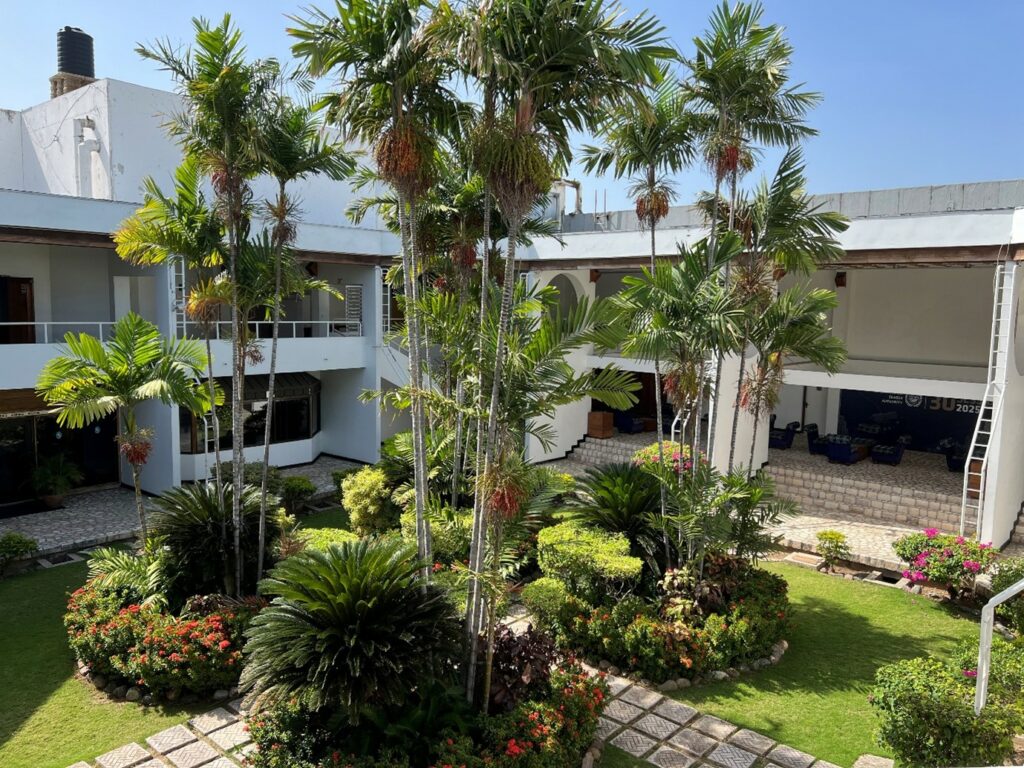
After long and conflictual hours in the negotiation room, the courtyard is a welcome reminder that we are in the Caribbean after all (Source: Emil W. Hildebrand)
Baby steps for a general environmental policy
Finally, we turn to the Assembly and ask: what came out of a week of negotiations in the supreme body of the ISA?
Not much, some would say.
To be fair, the ISA did officially adopt an “international day of the deep seabed” as a 30th birthday gift to itself. The day is set to be on the 1st of November and received the full support from the member states. The rest of the Assembly’s agenda got more contentious, however.
For the last two years, states have worked to put a general environmental policy on the Assembly’s agenda. Such a policy, championed by Chile, is envisioned to set high-level environmental objectives for the ISA and to give directions to the different bodies on how to fulfil the authority’s environmental obligations under UNCLOS. The concept note prepared by Chile can be found here. So far, however, the general policy has not even made it onto the agenda. On the basis that a general policy would distract attention away from efforts of developing the Mining Code, China and a few other likeminded countries have continued to oppose any discussion of the matter.
This year, for the first time, agenda item 16: “Need for a general policy of the Authority for the protection and preservation of the marine environment: scope and parameters” made its way onto the officially adopted agenda on Assembly’s first day, after a lengthy debate and an unwillingness from China to formally object to its inclusion. What this meant in practice, however, is that the same lengthy debate was held once more on the last day of Assembly, discussing whether or not an intersessional dialogue on the need for a general policy should be established. In the end the decision was deferred, meaning no intersessional dialogue. The process can be frustrating to watch. Especially considering what is being so hotly debated is not a general policy itself, but rather the need for a discussion on the need for a dialogue on the need for a general policy. As one delegate put it, rather defeatedly: “We can’t even agree to disagree”.
A similar dynamic was seen on item 9. “Periodic review of the international regime of the Area pursuant to article 154 of the Convention” – a general stock-taking of the ISA’s work and the management of the international seabed that the ISA is obliged under UNCLOS to do every five years. A periodic review is supposed to evaluate the current state of affairs and to stake out a strategic path forward for the authority. In its 30-year history, one such review has taken place, in 2017. This year again, and in a similar fashion to the general policy, the periodic review was blocked and deferred to next year.
On the bright side
All is not bleak in the deep-sea world, however. Following the negotiations in March and July, I’m surprised to see that even ardent pro-mining countries are willing to find some compromise on certain environmental protection measures, reporting and monitoring provisions, and scientific requirements. Disregarding a few notable exceptions mentioned above, the negotiations are moving forward in its own slow pace, and countries do seem to negotiate in rather good faith, at least much of the time. The slow progress of developing the Mining Code stems just as much from the complex nature of the matter as from a lack of constructiveness. To put timescales into perspective: a potato-sized polymetallic nodule takes somewhere between 5 to 15 million years to form and some deep-sea organisms can live to over 10 000 years (a single individual, that is). That developing sound regulations for such environments takes time seems only fitting.
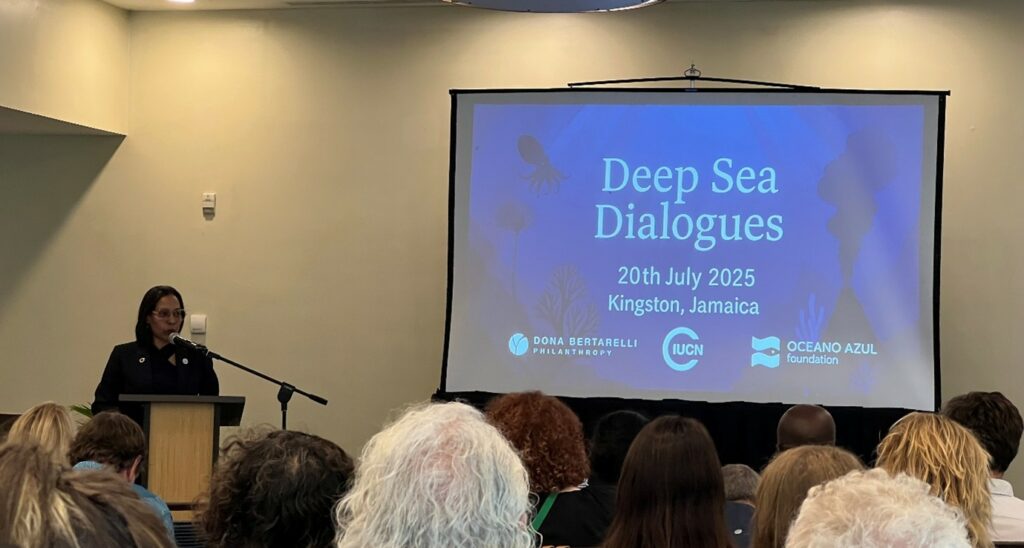
Secretary-General Leticia Reis de Carvalho speaking at the Deep Sea Dialogues side event, hosted by IUCN, Dona Bertarelli Philanthropy, and Oceano Azul Foundation (Source: Emil W. Hildebrand)
A welcome addition this year was a side event titled Deep Sea Dialogues organised by IUCN, Dona Bertarelli Philanthropy, and Oceano Azul Foundation on Sunday, July 20th. The event consisted of three panels, each tackling one major pillar of the ISA’s work: Economics, law, and marine science. The event itself was well put together and provided a good overview of the state of knowledge in three fields that are essential to the work of the ISA. But even more important was the fact that key takeaways from the event were presented to Assembly on Wednesday, July 23rd by Pradeep Singh, Diva Amon, and Rashid Sumaila, moderated by Minna Epps. The input of experts in the field is usually reserved for side events or informal channels, and it was positive to see it formally included in the negotiation schedule. Hopefully the Deep Sea Dialogues will continue also in future meetings.
Other highlights included a high-level side event co-hosted by Germany and Belgium on the MiningImpact project, which was well attended by policymakers, industry, and civil society alike. General-Secretary Leticia Carvalho emphasized the importance of evidence and science driven decision-making and deep-sea researchers Matthias Haeckel, Sabine Gollner, and Ellen Pape presented their findings on the impacts of mining activities in the German and Belgian contractor areas. The presentations were followed by engaged comments, questions, and what seemed like genuine interest from delegates – a welcome change after days of formal statements in the negotiation room which tend to be rather formulaic and dry.
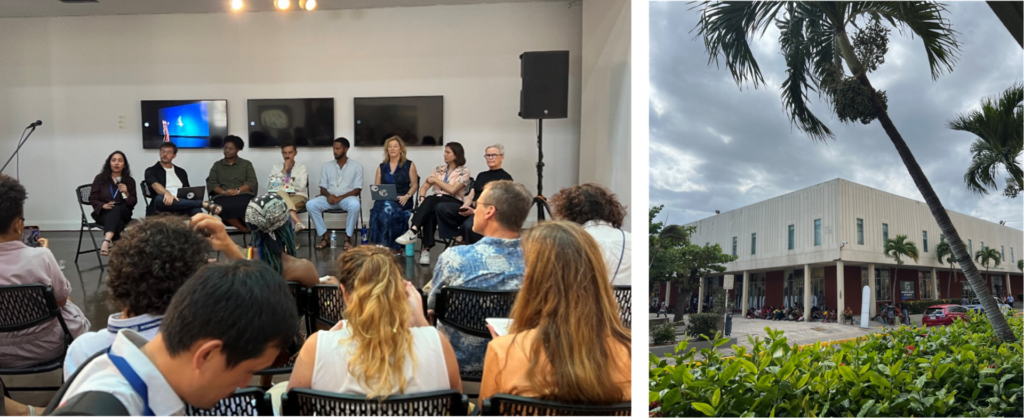
Side event by the Deep Currents Collective, one of the few events that was open to the public (Source: Emil W. Hildebrand)
Finally, a side event at the National Gallery of Jamaica was organised by the Deep Currents Collective. The event brought together artists, scholars, activists, and local community members and provided a much-welcomed perspective change away from the technical, economic, legal, and scientific focus of the negotiations. The intangible value and the richness of the sea can easily be forgotten in the bubble of multilateral diplomacy, and sometimes other voices and other views are needed to remind us that the deep-sea is after all a lot more than just an object of regulation.
Looking forward: Conclusion and future visions
As the dust settles after the 30th Session of the ISA, we are left with a mixed picture. The deep-sea mining negotiations remains a complex mix of diplomacy, geopolitics, technology, science, economics, traditional knowledge, and culture. The ISA continues its steady and sometimes bumpy work towards a Mining Code, while broader questions of environmental protection, institutional legitimacy, economic benefit-sharing, and threats of unilateral action loom large over the process. It is increasingly hard to predict what comes next, and the different visions for the future of the deep-sea and the ISA seem to be evermore diverging. Some states are continuing to push for a sole focus on the Mining Code – with the understanding that the ISA’s main role is to facilitate the nascent deep-sea mining industry. But as the call for a moratorium continues to grow, and keeping in mind the triple mandate of the ISA as not only Mining Code developer but also environmental protector and marine research facilitator, one has to ask what other futures may be possible for the ISA. Voices are beginning to emerge that envision a different role for the ISA, reimagining it as a steward of the deep-sea and as the central hub for deep-sea knowledge. As France put it in a statement on the second-to last day of Assembly: we can imagine “Kingston and the Authority as the beating heart of oceanic science on the deep seabed”.
Until then I will continue to follow the world of deep-sea mining and the development of the Mining Code closely. Stay tuned for more reports like this, as well as research output from me and the TwinPolitics team on deep-sea mining, plastics negotiations, the BBNJ process, and the development of Digital Twins of the Ocean.
Find Emil’s blog post on the Council of ISA here: Big challenges, careful progress, and last-minute drama in deep-sea mining negotiations – Twin Politics
Find our Ocean Data Survey here: Ocean Data Survey – Twin Politics
Find other blogs on conference participation here: Blog – Twin Politics