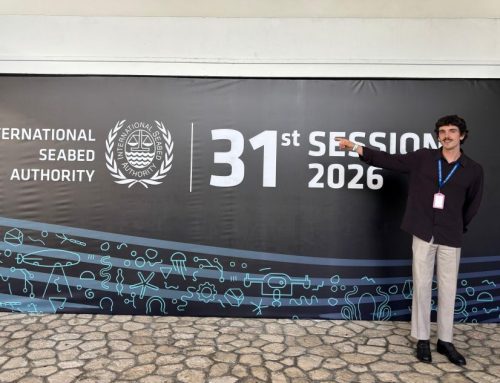
The EMODnet Open Conference and the Digital Ocean Forum #4 both took place in Brussels from November 25 – 28, 2025. Our TwinPolitics researcher Carolin Hirt and Felix Wurm attended both events to announce the TwinPolitics Ocean Data Survey, and to conduct fieldwork in the form of hybrid ethnography together with Hristina Talkova, who supported digitally from Vienna, and on-site expert interviews. This fieldwork data will provide data for Hirt’s doctoral research on the European Digital Twin of the Ocean. The fieldwork revealed a broad picture of the role of EMODnet and what a fully operational European Digital Twin of the Ocean should do, but leaves question about its limitations unanswered.
Written by Carolin Hirt & Felix Wurm
This activity is conducted as part of the Collaborative Event Ethnography (CEE) under the TwinPolitics project, led by Prof. Alice Vadrot and funded by the European Research Council. Other venues include the BBNJ Negotiations, negotiations for a global Plastics treaty (INC) and those of the International Seabed Authority.
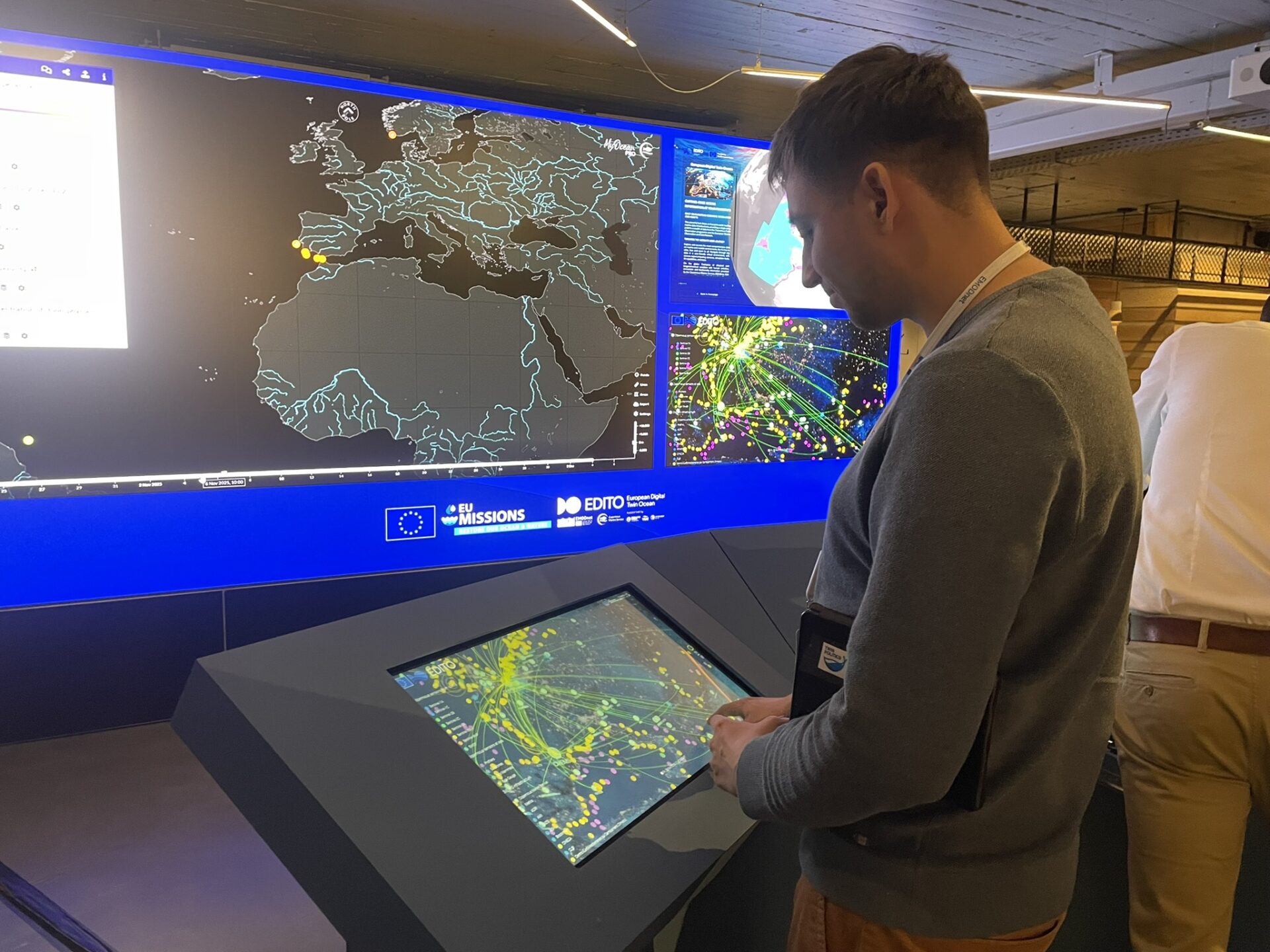
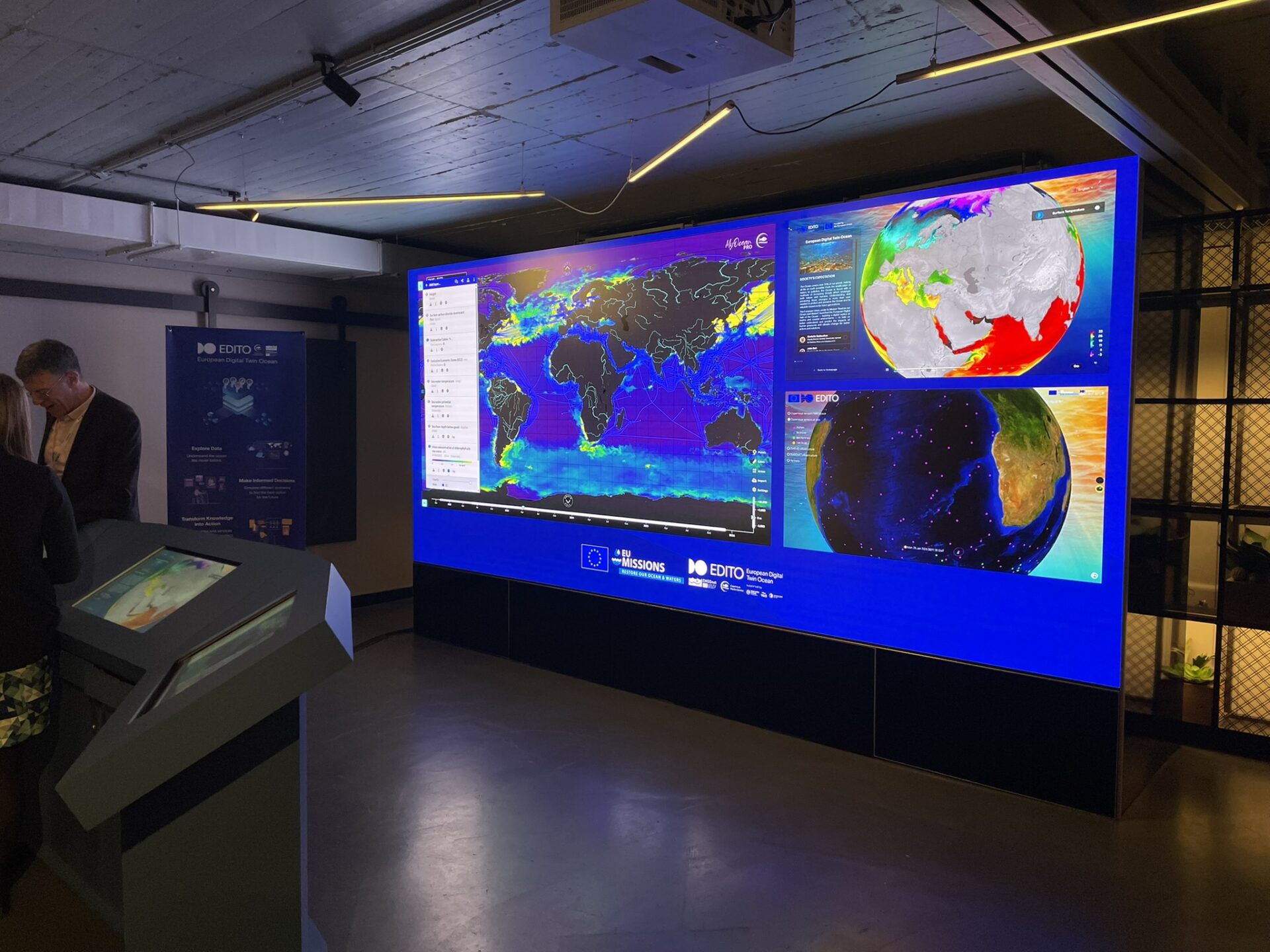
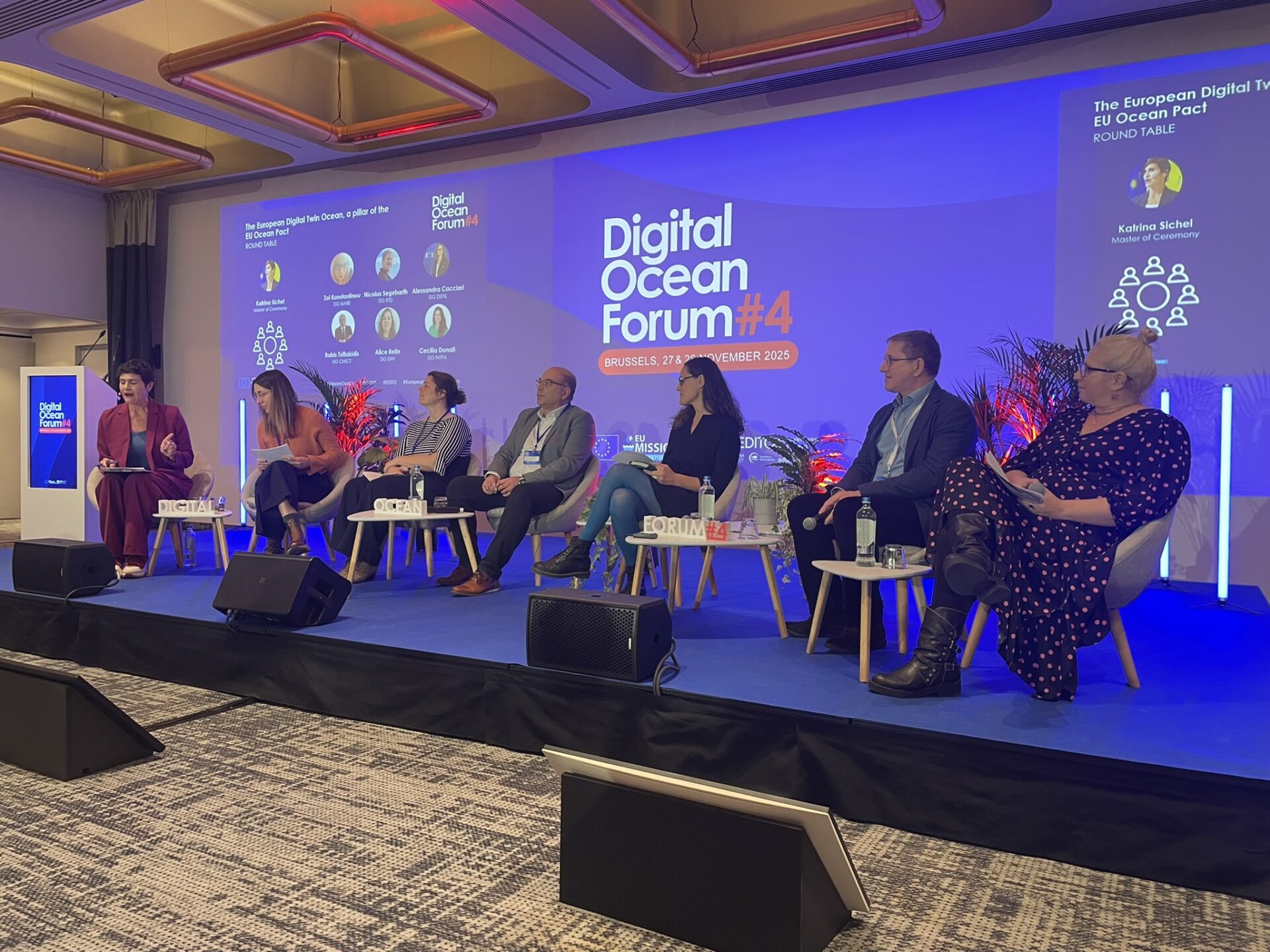
When observing the development of the EU Digital Twin of the Ocean (EU DTO), the Digital Ocean Forum (DOF) is an annual fixture and an important research site, as it represents a focal point for current EU DTO developments. This year’s forum is organized by the European Commission’s (EC) Directorate-General for Research and Innovation (DG RTD), Maritime Affairs and Fisheries (DG MARE), Defence Industry and Space (DG DEFIS), and International Partnerships (DG INTPA), together with the leading implementing institutions Mercator Ocean International, Flanders Marine Institute and SeaScape Belgium. The DOF aims to bring together project leaders and other stakeholders such as policymakers, active and potential future users, scientists, business partners, and representatives of similar projects in Europe to share the advances and the latest developments, and to further co-design the EU DTO. In total there were around 200 participants on-site and the forum itself consisted of a variety of formats like presentations, round tables, as well as more user-centric break-out sessions. Furthermore, there was a demo version of the EU DTO present on-site, that allowed participants to get a hands-on experience, as well as an “exhibition”, presenting different projects and other digital twins that already are or will be connected with the EU DTO.
The two days leading up to the Digital Ocean Forum began with the EMODnet Open Conference, where EMODnet, the in-situ data network, as a central pillar of the European Ocean Pact and the DTO ecosystem was presented. While the EMODnet Open Conference focused on the operational foundations and institutional coordination that make the EU DTO’s ambitions possible, the DOF spotlighted the long-term ambitions of the EU DTO itself.
Building the Community: EMODnet Vision 2035 and EDITO 2
The EMODnet Open Conference audience shaped much of the atmosphere. Participants came mostly from national data centers, research institutes and marine agencies already involved in day-to-day operations. Sessions focused heavily on technical and organizational matters, yet a parallel effort emerged to underscore the network’s identity as a community of practice. In her opening remarks, EMODnet Head of Secretariat Kate Larkin framed it as “a network of experts,” noting that the partnership now encompasses 133 institutions across 33 countries. That description resurfaced throughout the conference, emphasizing that its authority stems from long-standing cooperation among a broad range of actors rather than any single central service.
This community emphasis set the stage for the conference’s central announcement: the release of the EMODnet Community Vision 2035. The document outlines how the marine data service aims to evolve in response to the European Ocean Pact—introduced at the 2025 UN Ocean Conference in Nice (see blogpost “Inside the Whale – Fieldwork on Digital Twins at the Green Zone of the UN Ocean Conference 2025”)—and rising expectations surrounding integrated marine knowledge and data. It presents an ambition to become a “robust, fully comprehensive and actionable” service capable of delivering interoperable data at the scope and timeliness required for EU policy, research, international reporting obligations, and the operational needs of the EU DTO. The roadmap targets consolidating coordination and partnerships through 2028, then scaling operations for a “transformative marine data service” by 2035. However, practical tensions emerged: achieving these objectives requires doubling the annual core budget from 7 to 14 million euros. As Kate Larkin noted, even sustaining current operations demands “continuous and human-resource intensive” effort.
The DOF echoed this community focus but with broader scope. Unlike last year’s DOF, this forum prioritized scaling infrastructure and expanding participation—aligning with the main objective of EDITO 2, launched in March 2025. While EDITO 1 built core infrastructure with oceanographic experts, EDITO 2 aims to broaden access to non-experts and connect with other EU initiatives including Destination Earth. Also, a key announcement within the EDITO 2 project was the goal of achieving a fully operational EU DTO by 2030.
The EU Ocean Pact: Policy Agendas and Geopolitical Stakes
In addition to the strong community and user focus, the already mentioned EU Ocean Pact was a key theme throughout the forum. It was emphasized that the EU DTO will be the key tool in tracking, monitoring and implementing the pact’s objectives. In this context, presentations and round tables at the DOF showcased the various ways in which the EU DTO could help achieve scientific and political goals across different DGs in the future:
DG MARE sees the platform bridging marine science and coastal communities for resilience and blue economy development. DG INTPA emphasized ocean diplomacy through the Global Gateway strategy, building digital partnerships with the Global South. DG DEFIS highlighted democratized access to Copernicus satellite data for local decision-makers. DG ENVI stated, “we can only protect what we understand” and in this context the EU DTO should support authorities at all levels in evaluating ocean legislation through what-if scenarios in the future. By making indicators and assessments more accessible, the EU DTO aims to provide a “window to the world” for a wider range of users.
Geopolitical context surfaced around the EU Ocean Observation Initiative, “covering observation campaigns, data processing, infrastructures and the provision of key services, will be the next chapter in the discovery of our planet’s inner space and will connect, scale, govern and secure ocean observing capacities.” (EC 2025: 14) This initiative lies at the heart of the EU Ocean Pact and aims to provide the data needed for the EU DTO. In this context, geopolitical struggles and changes were present at the DOF. Though not explicitly named, speakers appeared to reference US funding cuts and expanding Chinese ocean observing initiatives. A DG MARE deputy emphasized that geopolitics are shifting fast, and the European Ocean Observing Initiative must be understood as a response to these shifts:
“In this context, marine knowledge is no longer just a scientific pursuit, it is a strategic asset. […] We have realized that to secure European autonomy, we must secure our understanding of the ocean, and we cannot manage what we cannot measure and we cannot protect what we do not understand. […] This is about technological and knowledge sovereignty as our ocean union aspiration by 2035 we want the European Union to be the global leader in ocean science, technology, security and management. We are setting the international standard.” – DG Mare
Missing from the Conversation: Social and Ecological Pitfalls
Taking a political science perspective on the EU DTO reveals its complexity: while aiming to make ocean knowledge accessible for environmental protection, it simultaneously serves geopolitical interests, blue economy expansion, and other policy objectives. The EU DTO must therefore be understood within its broader social and political context, rather than as a neutral digital technology that automatically leads to “better” decisions in a positivistic sense.
Critical reflection on the potential implications of a fully functional EU DTO for both society and the ocean itself was largely absent. While technical shortcomings such as missing or biased data within the EU DTO’s data lake were discussed both at the EMODnet Open Conference and the DOF, their societal and environmental consequences received little attention. Missing data—whether due to technical limitations or the systematic exclusion of local and indigenous knowledge—can create distorted realities and policy decisions based on incomplete digital representations risk perpetuating harm to underrepresented species, ecosystems, and communities (e.g., Gabrys et al. 2022; Westerlaken 2024). When specific species remain invisible within the EU DTO, protective measures cannot be implemented.
Beyond data gaps, the fundamental non-neutrality of data and technology has also to be pointed out. As Korenhof, Giesbers, and Sanderse state, producing any data collection involves countless decisions: what data to collect, which software and hardware to employ, what measuring systems to use, and in what form to present results (Korenhof, Giesbers, and Sanderse 2023: 2f.). Equally absent from discussions was any consideration of how algorithms and AI function within the EU DTO—a critical oversight given that these technologies risk perpetuating bias, unjust discrimination, and inequality through what scholars term representational or epistemic injustice (e.g., Helm et al. 2024; Kay et al. 2024, Zajko 2022).
Furthermore, throughout the DOF, blue economy expansion was featured prominently, while potential environmental and social impacts went largely unaddressed. Although the EU DTO may facilitate more sustainable approaches within the blue economy sector, the risks of intensifying ocean-based economic activities demand serious consideration. Growing scholarly evidence challenges the blue economy’s core assumption that social and economic goals can be simultaneously achieved within the current capitalist system predicated on infinite growth (Barbesgaard 2018; Hicks and Childs 2019; Noort et al. 2026). Research demonstrates that blue economy initiatives can create substantial justice risks for coastal communities, including displacement, inequitable distribution of economic harms and benefits, and exclusion from decision-making and governance processes (Noort et al. 2026). In Ghana, industrial fishing expansion driven by blue economy ambitions has already undermined artisanal fisheries through resource depletion, gear damage, and disruption of local market systems—threatening the economic, social, and cultural foundations of coastal livelihoods (Ayilu, Fabinyi, and Barclay 2022). The absence of critical examination into how intensified ocean exploitation affects vulnerable coastal communities and ecosystems means the EU DTO risks enabling harmful development patterns rather than genuinely sustainable governance.
To conclude, while the EU DTO aims to produce an objective reflection of reality, a critical reflection about its limitations and implications seems important. As Westerlaken argues, “Rather than aiming to create complete copies or twins of environmental phenomena, technologists must deliberately acknowledge and identify their partial representations” (Westerlaken 2024: 591). This becomes essential given the EU DTO’s ambition to provide applications, what-if scenarios and visualizations to impact all ocean-related policymaking, at local, national and international levels.
As the DOF was organized by the EC and the EU DTO’s leading institutions, it comes as no surprise that the event seemed like a big PR spectacle for the EU DTO and its related initiatives. However, a critical discussion between the creators and future users and those potentially affected, would help create trust and space to reflect on what the EU DTO could and should do in the future. This matters because the EU DTO, once fully operational, will fundamentally shape how we perceive and make sense of the ocean.
Sources
Ayilu, Raymond K., Michael Fabinyi, and Kate Barclay. 2022. “Small-Scale Fisheries in the Blue Economy: Review of Scholarly Papers and Multilateral Documents.” Ocean & Coastal Management 216:105982. doi:10.1016/j.ocecoaman.2021.105982.
Barbesgaard, Mads. 2018. “Blue Growth: Savior or Ocean Grabbing?” The Journal of Peasant Studies 45(1):130–49. doi:10.1080/03066150.2017.1377186.
- 2025.The European Ocean Pact.
Gabrys, Jennifer, Michelle Westerlaken, Danilo Urzedo, Max Ritts, and Trishant Simlai. 2022. “Reworking the Political in Digital Forests: The Cosmopolitics of Socio-Technical Worlds.” Progress in Environmental Geography 1(1–4):58–83. doi:10.1177/27539687221117836.
Helm, Paula, Gábor Bella, Gertraud Koch, and Fausto Giunchiglia. 2024. “Diversity and Language Technology: How Language Modeling Bias Causes Epistemic Injustice.” Ethics and Information Technology 26(1):8. doi:10.1007/s10676-023-09742-6.
Hicks, Christina Chemtai, and John Childs. 2019. “Securing the Blue: Political Ecologies of the Blue Economy in Africa.” Journal of Political Ecology 26(1). doi:10.2458/v26i1.23162.
Korenhof, P., E. Giesbers, and J. Sanderse. 2023. “Contextualizing Realism: An Analysis of Acts of Seeing and Recording in Digital Twin Datafication.” Big Data and Society 10(1). doi:10.1177/20539517231155061.
Noort, Carolijn Van, Mia Cassidy Prall, Furqan Asif, and Nelson F. Coelho. 2026. “Conceptualizing the Interplay between Blue Justice, Blue Economy, and Blue Governance.” Marine Policy 184:106939. doi:10.1016/j.marpol.2025.106939.
Westerlaken, Michelle. 2024. “Digital Twins and the Digital Logics of Biodiversity.” Social Studies of Science 54(4):575–97. doi:10.1177/03063127241236809.
Zajko, Mike. 2022. “Artificial Intelligence, Algorithms, and Social Inequality: Sociological Contributions to Contemporary Debates.” Sociology Compass 16(3):e12962. doi:10.1111/soc4.12962.