A new Open Access article published in the journal Marine Policy by Wenwen Lyu, Arne Langlet-Uranüs and Alice Vadrot from the University of Vienna sheds light on how debates over data are shaping the future of ocean data governance in Areas beyond National Jurisdiction (ABNJ). Their research examines how discussions during international negotiations for the Biodiversity Beyond National Jurisdiction (BBNJ) Agreement reveal competing visions about what data is, who controls it, and how it should be governed,
The study shows that data plays a dual role in the BBNJ Agreement: it is essential for implementing conservation and sustainable-use measures in ABNJ and the Agreement itself will also shape how data is governed in ABNJ. Central to this dynamic is the Clearing-House Mechanism (ClHM), the data infrastructure designed to support the BBNJ’s implementation.
Drawing on participant observations from BBNJ negotiations, the authors analyzed 835 observations in which delegates referenced “data.” Through an iterative and inductive coding process, they identified ten distinct “BBNJ Data Rationales” — patterns reflecting the expectations, understandings and interests different actors bring to discussions in relation to data. These data rationales are validated, reinforced, and reproduced through the making of the ClHM, the data infrastructure of BBNJ that has the potential to shape data governance in ABNJ.
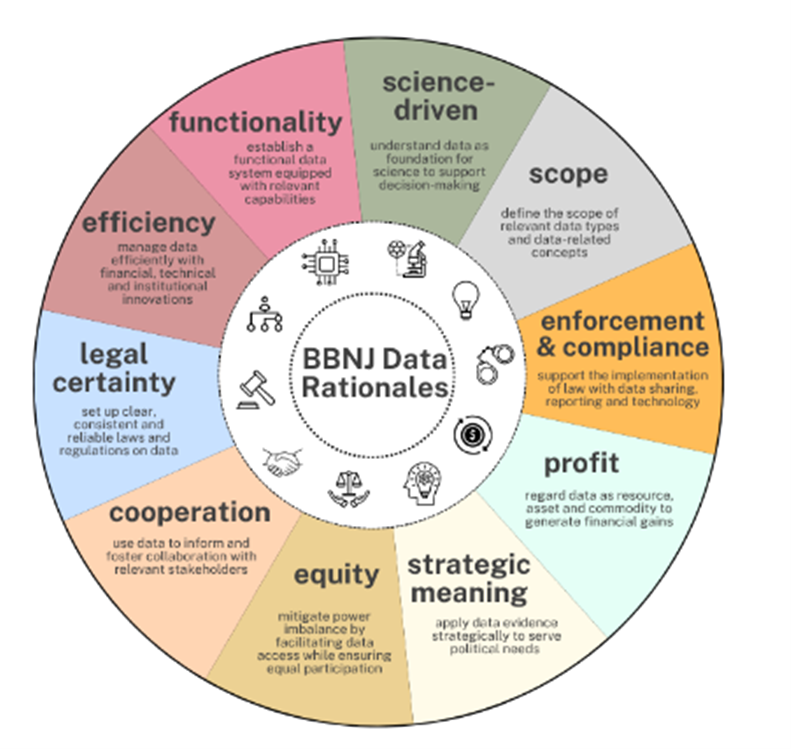
1 – Data Rationals of the BBNJ (Lyu, Langlet-Uranüs, Vadrot 2026)
“Debates over data and data infra structure are not merely technical. They are symbolic of broader struggles over access to and use of data in ABNJ,” the authors note.
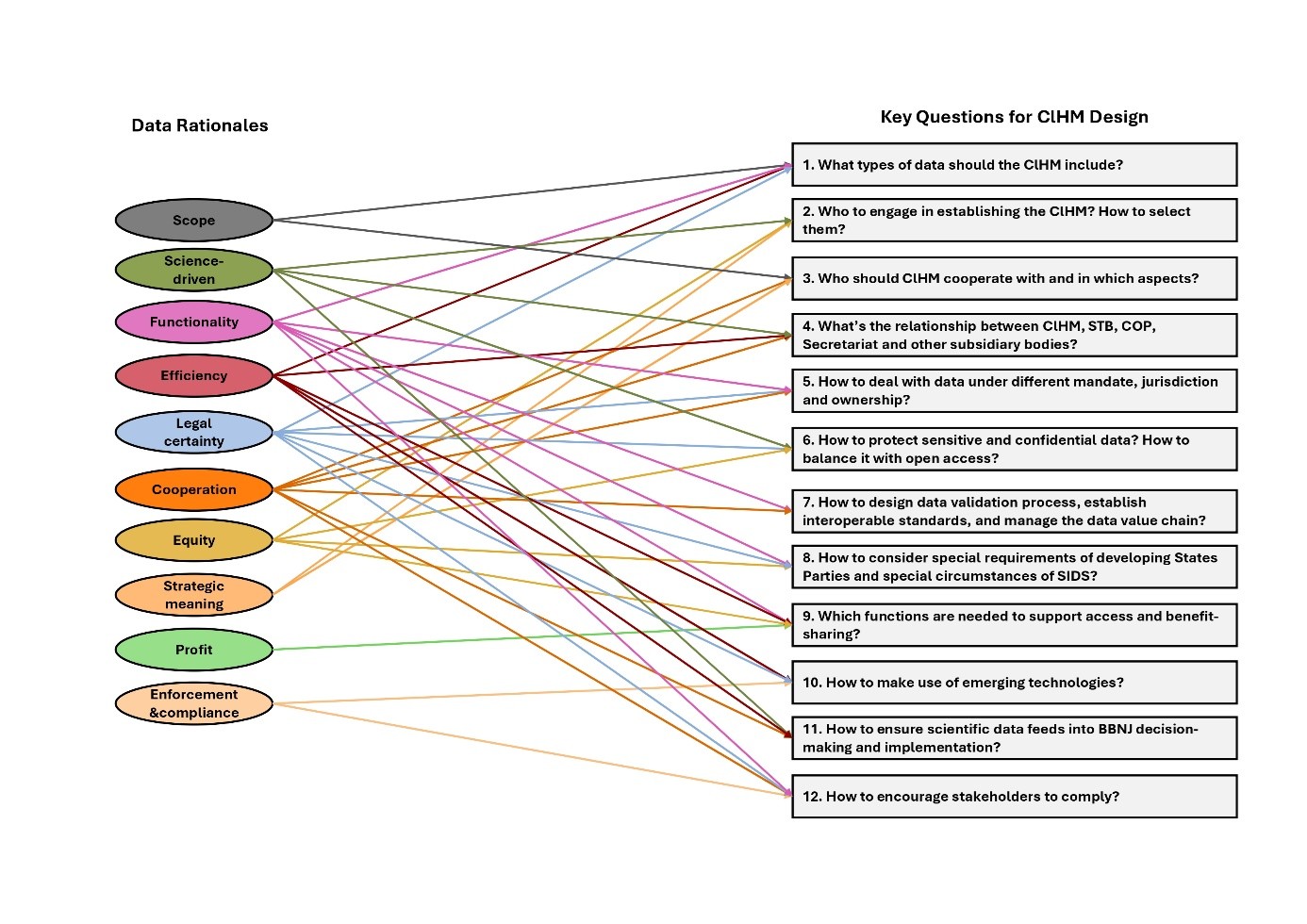
2- 12 key questions for ClHM design
The research further identifies twelve key policy questions that negotiators will need to address as they finalize the ClHM’s design. According to the study, the BBNJ process represents a rare window of opportunity: by openly negotiating competing data rationales, stakeholders can shape a more inclusive and equitable system for governing ocean data.
Why it matters
Areas beyond national jurisdiction cover nearly half the planet’s surface, yet governance structures for ABNJ are still emerging. Decisions made now about data infrastructure could determine who benefits from marine scientific data, who participates in decision-making, and how effectively marine biodiversity is protected.
TwinPolitics project at the University of Vienna
This research took place within the ERC (European Research Council) funded project TwinPolitics which is led by Vadrot at the Department of Political Science at the University of Vienna. TwinPolitics is researching the influence of digital twin technology on different settings of international, environmental negotiations. Among these negotiations are the negotiations on deep sea mining, an international plastics treaty, as well as the aforementioned BBNJ.
See the full publication here: From data rationales to data infrastructure: Implications for the BBNJ clearing-house mechanism – ScienceDirect
Suggested citation: Lyu, Wenwen, Langlet-Uranüs, Arne & Vadrot Alice B.M. (2026). From data rationales to data infrastructure: Implications for the BBNJ clearing-house mechanism. Marine Policy, 188, https://doi.org/10.1016/j.marpol.2026.107079.