
TwinPolitics employs collaborative event ethnography to study the usability and politics of DTOs in multilateral decision-making, with a particular emphasis on the needs of developing countries. Three doctoral research projects focus on three specific multilateral Ocean negotiation settings, including the UN Agreement on the Conservation and Sustainable Use of Marine Biological Diversity of Areas beyond National Jurisdiction (BBNJ), the International Seabed Authority (ISA), and the UN Treaty on plastic pollution. Each case involves fieldwork in at least two negotiation meetings. We complement on-site observations with digital ethnography and a survey.
Case 1: BBNJ Agreement
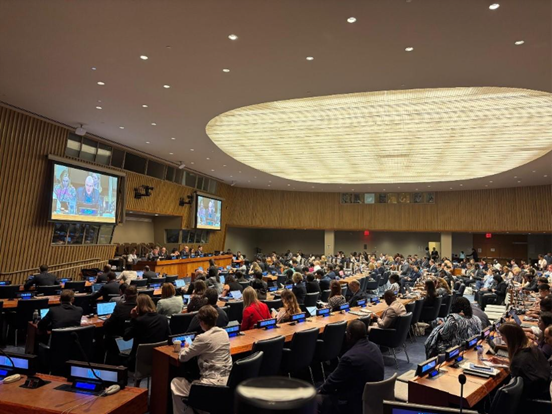
Negotiations unfolded in CR4, where the sessions were also broadcast live via webcast (Photo: Wenwen Lyu)
The BBNJ Agreement is the first legally binding international agreement under UN Convention on the Law of the Sea (UNCLOS) specifically for conserving marine life and ensuring sustainable use of biodiversity in areas beyond national jurisdiction (ABNJ), which will officially enter into force on January 17, 2026. The ongoing negotiations of the BBNJ Preparatory Commission (PrepCom) are focused on developing the institutional design in preparation for the first meeting of the Conference of the Parties (COP). TwinPolitics PhD Wenwen Lyu researches the actors, practices, and discourses surrounding data both within and beyond the BBNJ negotiations. Her research investigates how these dynamics shape data governance in ABNJ and explores how data governance in ABNJ can be achieved in a more equitable way.
For more info on our research on the BBNJ Agreement, see Wenwen Lyu’s blog posts from different BBNJ meetings here (April 2025), here (May 2025), and here (August 2025)
Case 2: International Seabed Authority (ISA)
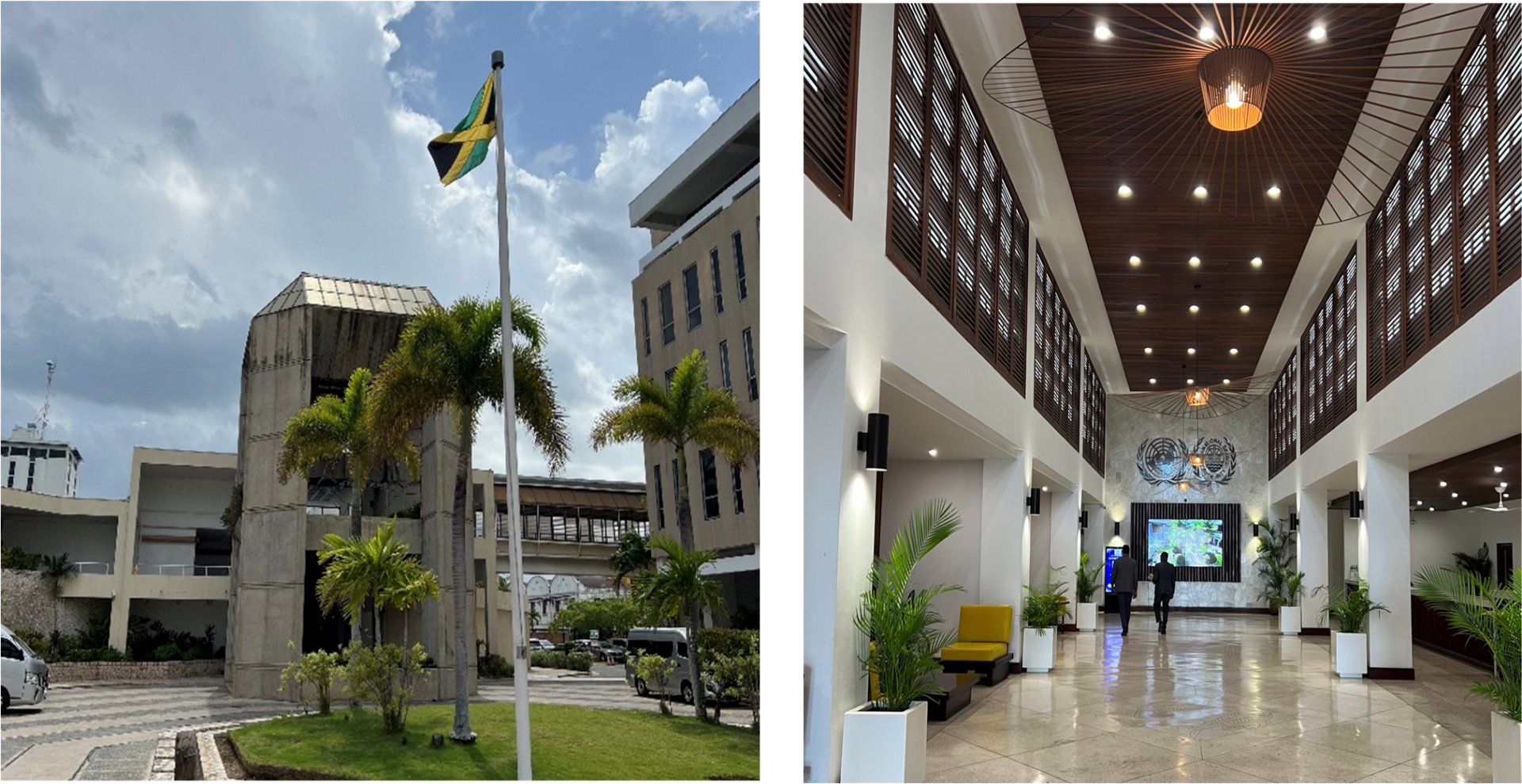
Entrance to the Jamaica Conference Centre in Kingston (Source: Emil W. Hildebrand)
The International Seabed Authority is the UN-mandated organisation tasked with governing the international seabed and its resources for the ‘benefit of humankind as a whole’. Ongoing negotiations at the ISA are focused on establishing the Mining Code – the rules and regulations for deep-sea mining. TwinPolitics doctoral researcher Emil W. Hildebrand investigates the production and use of science, data, and knowledge in these negotiations, and the role of the ISA as a promoter of deep-sea science. His research contributes to anticipating the future opportunities and challenges of emergent technologies such as DTOs in governing some of the most remote environments on Earth.
For more info on our research on the ISA, see Emil’s blog post Part I of the ISA’s 30th Session and Part II of the 30th Session
Case 3: Intergovernmental Negotiating Committee on Plastic Pollution
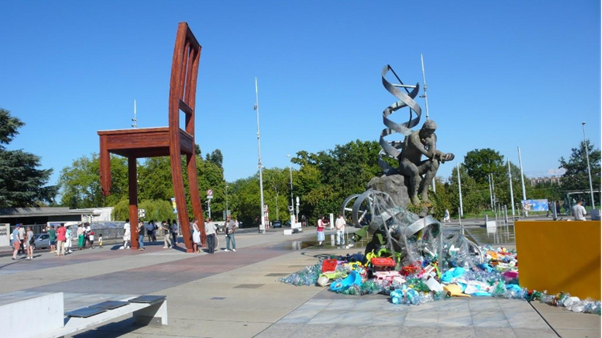
Art installation ‘The Thinker’s Burden’ created by Benjamin Von Wong. Over the course of the week, the statue was increasingly drowned in plastics (Photo: Felix Nütz)
The negotiations for a global plastics treaty are an ongoing multilateral process within the International Negotiating Committee (INC), which was convened by the UN Environmental Assembly (UNEA) in 2022. UNEA Resolution 5/14 requested the Executive Director of the UN Environment Programme (UNEP) to organize this negotiation platform. The INC has the goal of developing a legally binding instrument to end plastic pollution, based on a comprehensive approach that addresses the full life cycle of plastics. While the INC process was supposed to conclude at INC-5 in November 2024, states are still negotiating. A resumed session (INC-5.2) in August 2025 in Geneva, Switzerland, did not lead to the adoption of an agreement.
TwinPolitics researcher Felix Nütz has followed the INC process and is investigating how the contestation of the negotiations can be explained. He contributes a theoretically grounded perspective by conceptualizing negotiations as sites of global environmental agreement-making that have specific patterns of selectivity inscribed into them. He therefore links the developments within the INC to a broader trend of multilateral environmental negotiations that are increasingly contested.
For more info on our research on the Plastics Treaty, see Felix’ blog post on the fifth session on the INC in Busan and the INC – 5.2 in Geneva