The first Ocean Seminar of the 2026 Winter Semester dives into data and takes a look at the recent multilateral negotiations and how data and science influence these processes.
The Seminar takes place on Wednesday, September 23, at 5:00 pm (CET) – the Ocean Seminar is a digital, free event series for everyone interested in ocean governance and environmental politics.
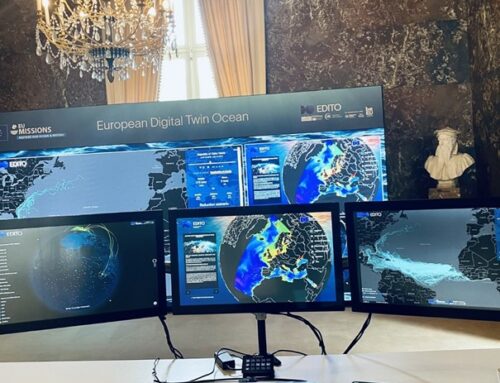
The TwinPolitics Ocean Seminar Series creates a space for discussion between experts from academia, policymaking, and NGOs to exchange ideas on ocean governance. The focus is on recent developments in data, science, and technology—particularly the Digital Twin of the Ocean (DTO)—and its role in shaping policies and practices.
We are also very proud that this seminar series is now recognized as an official Ocean Decade activity by the United Nations Decade of Ocean Science for Sustainable Development.
About the Speaker:
Muriel Rabone is a researcher based at the Natural History Museum’s Deep-Sea Systematics and Ecology Group; with expertise in deep-ocean biodiversity and Neglected Tropical Diseases, and over 50 peer reviewed publications. She has been involved in science-policy, in particular the BBNJ Agreement since 2017, and co-leads the Deep Ocean Stewardship Initiative working group for Marine Genetic Resources.
Introduction to the Topic:
Effective ocean governance requires the generation, synthesis and incorporation of reliable data and knowledge into policy generation and implementation. What does this involve? This seminar will explore the ocean data-governance nexus through two case studies. With the first Conference of the Parties of the Biodiversity Beyond National Jurisdiction (BBNJ) Agreement scheduled for Jan 2026, we will look at required data elements and infrastructures, including the standardised batch identifier for traceability of marine genetic resources, data management plans and the Clearing House Mechanism to be established under the agreement. We will also discuss environmental studies in the context of deep sea mining exploration activities, regulated by the International Seabed Authority. We will explore how to meet challenges in the flow of ocean data and findings into policy for effective ocean governance, and elements that can support this process, including roles for networks, engagement and holistic approaches.
Recommended literature
- Bloch Haimson, M., Lehahn, Y. and Sagi, T., 2025. An overview of the ocean data ecosystem. Ocean Science, 21(6), pp.3131-3164. https://doi.org/10.5194/os-21-3131-2025
- Drakopulos, L., Havice, E. and Campbell, L., 2022. Architecture, agency and ocean data science initiatives: Data-driven transformation of oceans governance. Earth System Governance, https://doi.org/10.1016/j.esg.2022.100140
- Durden, J. 2025. Environmental management using a digital twin. Environmental Science and Policy, 164, 1-9. https://doi.org/10.1016/j.envsci.2025.104018
- Harden-Davies, H.R. and Gjerde, K.M., 2019. Building scientific and technological capacity: a role for benefit-sharing in the conservation and sustainable use of marine biodiversity beyond national jurisdiction. Ocean YB, 33, p.377.
- Gaebel, C., Harden-Davies, H., Vierros, M.K., Caldeira, M., Coelho, L., Hassanali, K., Sekinarai, A. and Schütz Veiga, J., 2025. The BBNJ clearing-house mechanism: considerations for its diverse functions, users, and sources. Frontiers in Ocean Sustainability, 3, p.1584927.
- Krabbe, N. and Wagenaar, T., 2026. Ocean justice? Marine genetic resources and monetary benefit-sharing under the BBNJ Agreement. Marine Policy, 191, p.107150.
- Lawson, C., Humphries, F., Jaspars, M. and Rabone, M., 2025. Data Management and the ‘BBNJ’ Standardized Batch Identifier Under the BBNJ Agreement. In: Decoding Marine Genetic Resource Governance Under the BBNJ Agreement. Cham: Springer, pp.317-342.
- Pearlman, J., Bushnell, M., Coppola, L., Karstensen, J., Buttigieg, P.L., Pearlman, F., Simpson, P., Barbier, M., Muller-Karger, F.E., Munoz-Mas, C. and Pissierssens, P., 2019. Evolving and sustaining ocean best practices and standards for the next decade. Frontiers in Marine Science, 6, p.277. https://doi.org/10.3389/fmars.2019.00277
- Rabone, M., Wiethase, J.H., Simon-Lledó, E., Emery, A.M., Jones, D.O., Dahlgren, T.G., Bribiesca-Contreras, G., Wiklund, H., Horton, T. and Glover, A.G., 2023. How many metazoan species live in the world’s largest mineral exploration region?. Current biology, 33(12), pp.2383-2396.
- United Nations (forthcoming). Chapter 5A: Marine Genetic Resources. In: The Third World Ocean Assessment (WOA III). New York: United Nations Division for Ocean Affairs and the Law of the Sea. https://woa.un.org/
- Zhivkoplias, E., Jouffray, J.B., Dunshirn, P., Jaspars, M. and Blasiak, R., 2024. Growing prominence of deep-sea life in marine bioprospecting. Nature Sustainability, 7, pp.1027–1037.
Join Us!
📌 Register here: https://mailchi.mp/ed2568d2b8dd/ocean-seminar-lecture-series
📌 More information: https://twinpolitics.eu/
Most of the sessions will be recorded. The recordings will be made available to the public after receiving consent from the speakers.
Project Leader: Prof. Dr. Alice Vadrot – TwinPolitics Principal investigator, University of Vienna – alice.vadrot@univie.ac.at
Seminar Organiser – The TwinPolitics Team, Universtiy of Vienna – twinpolitics.erc.powi@univie.ac.at
This project has received funding from the European Research Council (ERC) under the European Union’s Horizon Europe research and innovation programme (grant agreement No 101124903 – TwinPolitics – ERC-2024-STG). Views and opinions expressed are however those of the author(s) only and do not necessarily reflect those of the European Union or the European Research Council. Neither the European Union nor the granting authority can be held responsible for them.