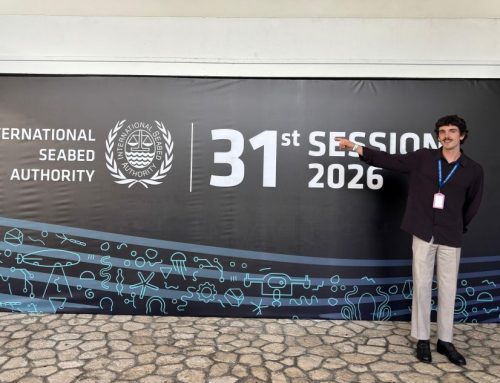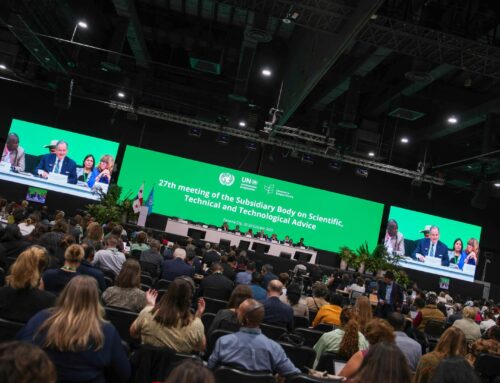
What happens away from the main stage of global environmental negotiations? What influence do the hundreds of side-events have that are organized in these multilateral settings and how can we investigate the communicative potential of these spaces? In her Ocean Seminar our guest researcher Chloé Taillandier from Open Universiteit looks at these side events for the INC negotiations for a global plastics treaty.
The Seminar is taking place on Wednesday, October 07, at 5:00 pm (CET) – the Ocean Seminars are digital, open to everyone and build a space for discussion between experts from academia, policymaking, and NGOs to exchange ideas on ocean governance. The focus is on recent developments in data, science, and technology—particularly the Digital Twin of the Ocean (DTO)—and its role in shaping policies and practices.
We are also very proud that this seminar series is now recognized as an official Ocean Decade activity by the United Nations Decade of Ocean Science for Sustainable Development.
Abstract
While international environmental negotiations have been studied for several decades, academics have recently called for a reshaping of what counts as negotiation, arguing that such processes extend beyond formal exchanges in plenaries or contact groups to include the informal interactions surrounding them. Yet what happens outside formal negotiation rooms, in informal spaces such as “side events”, remains largely understudied. This is all the more surprising given that side events have grown in both number and attendance over the past decades, and have become one of the most prominent forums for informal exchanges.
As organised informal communication platforms, side events can serve multiple functions across settings and processes (e.g. knowledge sharing, view/position sharing), generating outcomes and impacts both within and beyond the spatio-temporal boundaries of negotiations. Drawing on meetings of the Intergovernmental Negotiating Committee (INC) towards a global plastics treaty, the research further shows that side events facilitate a rich variety of communicative interactions that have led to outcomes (e.g. learning, networking) and impacts (i.e. negotiation-related, organisational, and societal impacts). However, side events do not automatically produce such outcomes and impacts, which are also dependent on contextual factors. These can either enable or constrain the translation of outcomes into further effects, particularly with regard to broader impacts.
About the speaker

Chloé Taillandier is a doctoral researcher at the Open Universiteit. Her research focuses on the role of side events, a form of organised informal interaction, in the context of the Intergovernmental Negotiating Committee (INC) towards a global plastics treaty.
Chloé holds a MSc in Sustainability Science, Policy and Society from Maastricht University, and a BA in European Studies from Clermont Auvergne University.
Suggested reading
Taillandier, C., Groen, L., de Kraker, J., Beunen, R., and Löhr, A.J. (2026). Beyond the formal spotlight−Unravelling side events in multilateral environmental negotiations: a review. Earth System Governance (27). https://doi.org/10.1016/j.esg.2025.100305
Join Us!
📌 Register here: https://mailchi.mp/ed2568d2b8dd/ocean-seminar-lecture-series
📌 More information: https://twinpolitics.eu/
Most of the sessions will be recorded. The recordings will be made available to the public after receiving consent from the speakers.
Project Leader: Prof. Dr. Alice Vadrot – TwinPolitics Principal investigator, University of Vienna – alice.vadrot@univie.ac.at
Seminar Organiser – The TwinPolitics Team, Universtiy of Vienna – twinpolitics.erc.powi@univie.ac.at
This project has received funding from the European Research Council (ERC) under the European Union’s Horizon Europe research and innovation programme (grant agreement No 101124903 – TwinPolitics – ERC-2024-STG). Views and opinions expressed are however those of the author(s) only and do not necessarily reflect those of the European Union or the European Research Council. Neither the European Union nor the granting authority can be held responsible for them.